
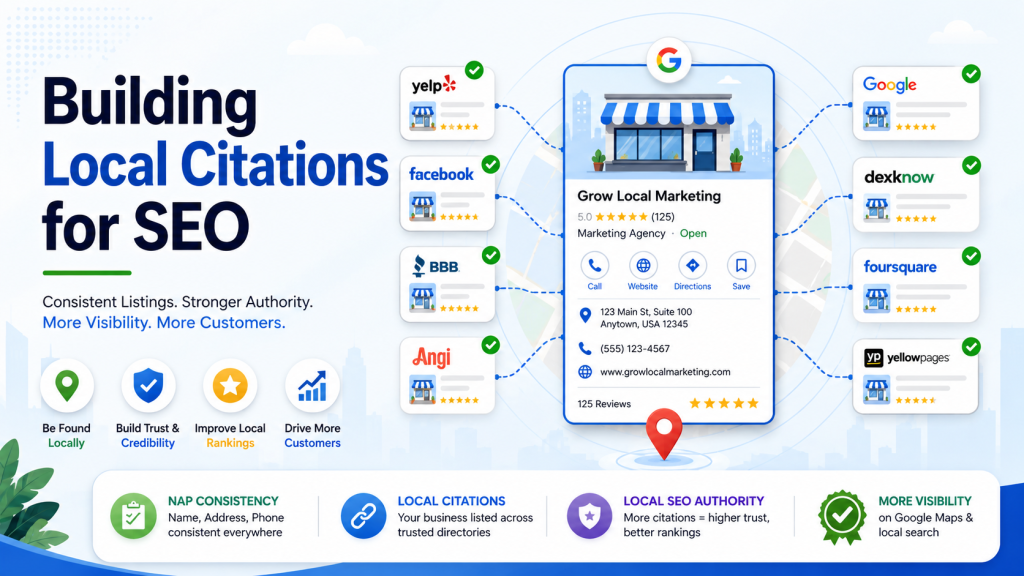
Building Local Citations for SEO: Why Consistent Business Mentions Still Matter for Google Maps Rankings
Building local citations for SEO is still one of the most important foundations of local search visibility. Even with Google Maps SEO, AI SEO, AEO, GEO, Google Business Profile optimization, and answer-based search becoming more important, search engines still need consistent business information to understand who a business is, where it is located, what it offers, and whether customers can trust it.
A local citation is any online mention of a business’s name, address, phone number, website, service area, category, or other identifying business information. These citations can appear on business directories, review sites, social media profiles, maps platforms, industry directories, local websites, chamber of commerce pages, news mentions, blogs, and trusted third-party platforms.
For local SEO, citations help create business identity consistency. For Google Maps rankings, they help support trust, prominence, and location confidence. For AI search and LLM-based recommendations, they help reinforce a business entity across the web so systems can better understand and reference the business accurately.
This is why citation consistency is important for any business trying to improve Google Maps rankings.
What Are Local Citations in SEO?
Local citations are online references to a business. The most common citation information is NAP, which stands for name, address, and phone number.
However, modern citation building goes beyond NAP.
A strong citation can include the business name, address, phone number, website URL, business categories, business description, services offered, hours of operation, appointment links, service areas, photos, social profiles, reviews, and other details that help search engines and customers understand the business.
For example, if a business wants to rank higher on Google Maps for local searches, its Google Business Profile should match the information found on major directories and trusted third-party websites. If Google sees one business name on the website, another name on Yelp, a different phone number on Facebook, and an old address on Apple Maps, that can create confusion.
The goal of local citation building is to reduce confusion and increase trust.
Why Local Citations Matter for Google Maps SEO
Google Maps SEO is influenced by several major signals, including relevance, distance, and prominence.
Citations mostly support relevance and prominence.
Relevance means how closely a business matches the search query. If a business is consistently listed as an SEO company, marketing agency, local SEO service provider, or Google Maps SEO company across trusted platforms, that repeated consistency helps search engines understand what the business does.
Prominence refers to how established, credible, and visible the business appears online. Citations can help support prominence because they show that the business is mentioned across multiple sources, directories, platforms, and local websites.
Citations do not work alone. They are not a replacement for a properly optimized Google Business Profile, strong reviews, quality service pages, local content, backlinks, schema markup, or customer engagement. But they help support those signals by creating consistency across the web.
When citation information is accurate, Google has more confidence in the business entity.
When citation information is inconsistent, Google may still show the business, but the business may be sending weaker trust signals.
This is why citation consistency is important for any business trying to improve Google Maps rankings.
The Role of NAP Consistency
NAP consistency means keeping the business name, address, and phone number the same across the internet.
This matters because search engines use this information to connect business mentions back to the same entity. If the same business appears with multiple addresses, phone numbers, or name variations, search engines may have a harder time understanding which information is correct.
For a local business, this can affect both visibility and customer experience.
A customer may find an old address and drive to the wrong location. A lead may call an outdated phone number. Google may discover conflicting information and reduce confidence in the listing.
NAP consistency is especially important for businesses that have moved locations, changed phone numbers, changed website domains, rebranded, opened new locations, closed old locations, or used tracking numbers without a proper citation strategy.
The cleaner the business data is across the web, the easier it becomes for Google and AI systems to understand the business accurately.
Structured Citations vs. Unstructured Citations
There are two main types of local citations: structured citations and unstructured citations.
Structured citations are business listings on platforms built to display business information. These include directories, maps platforms, review sites, and social profiles.
Examples include Google Business Profile, Apple Maps, Bing Places, Yelp, Facebook, BBB, Yellow Pages, Foursquare, Nextdoor, Angi, industry directories, and local chamber of commerce websites.
Structured citations usually include business name, address, phone number, website, hours, categories, and a short description.
Unstructured citations are business mentions that appear naturally within content. These can include blog posts, local news articles, sponsorship pages, event pages, podcast show notes, resource pages, press releases, local guides, and industry articles.
Both types matter.
Structured citations help confirm business data.
Unstructured citations help build brand authority, topical relevance, and local trust.
A strong local SEO strategy should include both.
Citation Quality Matters More Than Citation Quantity
Many business owners think citation building means submitting their business to hundreds of directories. That is not the best approach.
Citation quality matters more than citation quantity.
A citation from a trusted local website, chamber of commerce, industry association, respected business directory, or relevant niche platform is more valuable than a listing on a weak directory that exists only to publish business data.
Low-quality citations can create problems. They may duplicate listings, scrape wrong information, publish outdated details, or create inconsistent versions of the business online.
The goal is not to get listed everywhere.
The goal is to get listed accurately on the platforms that matter.
For most local businesses, citation building should begin with the major platforms. After that, the business should build industry-specific citations and local citations connected to its city, service area, or niche.
How Local Citations Help AI Search and LLM Visibility
AI search still needs trusted information.
When large language models, AI assistants, AI Overviews, and answer engines reference a business, they rely on information that exists across the web. They may use website content, business profiles, directories, reviews, third-party mentions, structured data, and other accessible sources to understand the business.
This is where citations can help.
If a business is mentioned consistently across multiple trusted sources, AI systems have more repeated confirmation of the business entity. That makes it easier for those systems to understand the business name, location, services, categories, reputation, and relevance.
This is important for AEO and GEO.
AEO, or Answer Engine Optimization, focuses on helping search engines and AI systems answer questions clearly.
GEO, or Generative Engine Optimization, focuses on helping AI systems understand, summarize, and recommend brands accurately.
Local citations support both because they reinforce consistent business information across the internet.
For example, if a business wants to be suggested when someone asks, “Who is a good Google Maps SEO company in Santa Monica?” the business needs more than a single optimized page. It needs a clear entity footprint.
That footprint can include a strong website, optimized Google Business Profile, accurate citations, local content, reviews, schema markup, service pages, backlinks, and third-party mentions.
Citations are part of that footprint.
The Connection Between Citations and Entity SEO
Search engines do not only look at keywords. They also try to understand entities.
An entity is a clearly identifiable person, business, place, brand, product, service, or organization.
For local SEO, your business is the entity.
Citation building helps search engines connect your business entity to specific facts.
Those facts can include:
- Business name
- Location
- Phone number
- Website
- Service area
- Business category
- Services offered
- Founder or team
- Reviews
- Social profiles
- Local relevance
- Industry relevance
When those facts are repeated consistently across trusted sources, the business entity becomes clearer.
This is why local citation building is also an entity SEO strategy.
It helps search engines and AI systems connect the dots.
How to Build Local Citations the Right Way
The first step is to make sure your Google Business Profile is accurate.
Your Google Business Profile should be the primary source of truth for your business information. Before building citations elsewhere, confirm that your business name, address, phone number, website, primary category, secondary categories, business hours, services, products, photos, and description are accurate.
The second step is to audit existing citations.
Search your business name, old business names, phone number, old phone numbers, address, old addresses, and website URL. Look for outdated listings, duplicate listings, incorrect phone numbers, wrong addresses, old domains, and inconsistent business descriptions.
The third step is to fix the most important listings first.
Start with the platforms customers and search engines are most likely to trust. These often include Google Business Profile, Apple Maps, Bing Places, Yelp, Facebook, BBB, Yellow Pages, Foursquare, Nextdoor, and other major directories.
The fourth step is to build niche citations.
A dentist should be listed on dental directories. A lawyer should be listed on legal directories. A contractor should be listed on home service platforms. A restaurant should be listed on food, travel, and review platforms. An SEO company should be listed on marketing directories, business directories, professional profiles, and relevant local platforms.
The fifth step is to build local citations.
Local citations can come from chamber of commerce websites, local sponsorships, local news websites, city business directories, community organizations, local blogs, networking groups, event pages, local partnerships, and business associations.
The sixth step is to monitor citations over time.
Citation building is not a one-time project. Business data changes. Directories update information. Duplicate listings appear. Old data can resurface. Aggregators can push incorrect details. A citation audit should be done at least once or twice per year, and anytime the business changes important information.
Common Local Citation Mistakes
The most common mistake is inconsistent business information.
Even small differences can create confusion when they appear across many platforms. One wrong phone number may not destroy a local SEO campaign, but many inconsistent listings can weaken trust.
Another mistake is keyword stuffing the business name.
Your business name should match the real business name used on your website, branding, legal documents, and Google Business Profile. Adding extra keywords to citation names can create problems and may violate platform guidelines.
Another mistake is ignoring duplicate listings.
Duplicate listings can split authority, confuse customers, and create conflicting information. If there are multiple listings for the same business on the same platform, they should be cleaned up, merged, removed, or corrected whenever possible.
Another mistake is using low-quality citation services without reviewing the results.
Some automated citation services may submit information to weak directories or create listings that are hard to update later. Automation can be useful, but accuracy matters more than speed.
Another mistake is failing to update citations after a move or rebrand.
If your business moves, changes phone numbers, changes websites, or rebrands, old citations should be corrected. Otherwise, outdated information may continue appearing in search results and AI summaries.
How Citations Support Service Pages and Location Pages
Citations work best when they support a strong website structure.
A business should not rely only on its Google Business Profile. The website should have clear service pages, location pages, internal links, schema markup, FAQs, and helpful content that explains what the business does.
Citations then reinforce that website structure by confirming the business details across the web.
For example, if a business has a page about Google Maps SEO services in Santa Monica, its citations should support the same business name, location, website, category, and service focus.
This creates alignment between the website, Google Business Profile, and third-party platforms.
That alignment helps Google and AI systems understand the business more clearly.
When the website says one thing, the Google Business Profile says the same thing, and trusted citations confirm it, the local SEO foundation becomes stronger.
Local Citations and Review Signals
Citations and reviews often work together.
Many citation platforms also collect customer reviews. Yelp, Facebook, BBB, Google Business Profile, industry directories, and local platforms can all display customer feedback.
This matters because reviews add trust and social proof.
A citation tells search engines the business exists.
A review tells customers and search engines that people have interacted with the business.
A complete local SEO strategy should not only build citations but also improve review generation, review responses, and reputation management.
Reviews help increase conversion. Citations help customers find the correct business information. Together, they support local trust.
How Citations Help Multi-Location Businesses
Citation consistency becomes even more important for multi-location businesses.
Each location should have its own accurate business information. That includes the correct address, phone number, landing page, business hours, categories, services, photos, and local references.
Multi-location businesses often have problems with duplicate listings, wrong phone numbers, old addresses, closed locations, and mismatched landing pages.
Each location should have a dedicated location page on the website and a properly optimized Google Business Profile. Citations should match each location individually.
This helps Google understand that each location is part of the same brand but serves a specific geographic area.
Without proper citation management, multi-location businesses can create confusion across search engines, directories, and AI systems.
What Makes a Strong Citation Source?
A strong citation source is trusted, relevant, crawlable, and accurate.
Trusted means the platform has authority and is known by customers or search engines.
Relevant means the platform connects to your industry, location, or audience.
Crawlable means search engines can discover and read the listing.
Accurate means the citation displays correct business information.
The best citation sources are usually a combination of major directories, niche directories, local organizations, maps platforms, review platforms, social profiles, and real local mentions.
For a local business, a citation from a local chamber of commerce, city guide, local news article, sponsorship page, or relevant business association can be very valuable because it connects the business to a real geographic market.
This is why local citation building should not only be about directories. It should also be about local authority.
How to Know If Your Citation Strategy Is Working
Citation building should support measurable local SEO improvements.
You can track progress by monitoring Google Maps rankings, Google Business Profile actions, website traffic, direction requests, phone calls, form submissions, branded searches, discovery searches, and local keyword visibility.
You should also track whether incorrect listings have been fixed, duplicates have been removed, and important citation platforms are accurate.
The goal is not only to have more citations.
The goal is to improve the business’s local search confidence, map visibility, customer trust, and conversion opportunities.
A strong citation strategy should make the business easier to find, easier to verify, and easier to contact.
Why Citation Building Should Be Part of Every Google Maps SEO Strategy
Google Maps SEO is not based on one action.
It is built through many signals working together.
A complete Google Maps SEO strategy should include Google Business Profile optimization, category selection, service optimization, local citations, NAP consistency, review generation, review responses, local landing pages, schema markup, photo optimization, Google Posts, Q&A optimization, website authority, internal linking, and ongoing rank tracking.
Citations support the foundation.
They help confirm that the business exists, operates in a specific market, and provides specific services.
When citations are accurate and consistent, they support the larger SEO strategy.
When they are ignored, they can create unnecessary confusion.
Final Thoughts
Building local citations for SEO still matters because local search depends on trust, consistency, and entity clarity.
A business that wants to rank better on Google Maps needs more than keywords. It needs accurate business information across the web, a strong Google Business Profile, quality reviews, optimized service pages, local authority, and consistent third-party mentions.
Citations help connect those pieces.
They support Google Maps rankings, improve customer trust, reinforce business identity, and help AI systems understand the business more accurately.
For business owners, citation building should be viewed as a foundational part of local SEO, not a one-time checklist item.
The stronger and cleaner your business information is across the internet, the easier it becomes for Google, customers, and AI systems to understand who you are, where you are, and why your business should be recommended.
FAQs
What are local citations in SEO?
Local citations are online mentions of a business’s name, address, phone number, website, or other important business information. They can appear on directories, review sites, social media profiles, local websites, maps platforms, industry directories, blogs, and news sites. Citations help search engines verify that a business is real, active, and connected to a specific location or service area.
Do local citations still help Google Maps rankings?
Yes, local citations can still help Google Maps rankings because they support trust, consistency, prominence, and business identity. Citations are not the only ranking factor, but accurate listings across trusted platforms can help Google better understand and verify a business. They work best when combined with Google Business Profile optimization, reviews, service pages, schema markup, and local content.
What is NAP consistency?
NAP consistency means keeping a business’s name, address, and phone number accurate and consistent across the internet. This matters because search engines use NAP information to connect business mentions back to the same entity. If a business has conflicting names, phone numbers, or addresses online, it can create confusion for both search engines and customers.
How do citations help AI search visibility?
Citations help AI search visibility by reinforcing a business entity across multiple trusted sources. AI systems and large language models often rely on information that already exists online. When a business has consistent citations, reviews, website content, schema, and third-party mentions, AI systems have more reliable information to understand and reference the business accurately.
What are the best citation sites for local SEO?
The best citation sites depend on the business and industry, but most businesses should start with major platforms like Google Business Profile, Apple Maps, Bing Places, Yelp, Facebook, BBB, Yellow Pages, Foursquare, and Nextdoor. After that, businesses should build citations on niche industry directories, chamber of commerce websites, local business associations, local news sites, and relevant community platforms.
How often should citations be audited?
Citations should be audited at least once or twice per year. They should also be audited anytime a business moves, changes phone numbers, changes its website, rebrands, opens a new location, closes a location, or changes its service area. Regular citation audits help prevent outdated or incorrect business information from spreading online.
Are local citations better than backlinks?
Local citations and backlinks serve different purposes. Citations help confirm business information and support local trust. Backlinks help build authority and pass ranking signals from other websites. The best local SEO strategy uses both. A business should have accurate citations, strong local backlinks, optimized service pages, and a complete Google Business Profile.
Can wrong citations hurt local SEO?
Wrong citations can hurt local SEO by creating confusion. If a business has old addresses, wrong phone numbers, duplicate listings, or inconsistent names across the web, search engines may have less confidence in the business information. Customers may also contact the wrong number or visit the wrong location. Cleaning up incorrect citations is an important part of local SEO.
Should service-area businesses build citations?
Yes, service-area businesses should build citations. Even if the business does not display a storefront address, it still needs consistent business information across trusted platforms. Service-area businesses should make sure their Google Business Profile, website, directories, and citations accurately reflect their service areas, phone number, website, categories, and services.
What is the best way to build local citations for SEO?
The best way to build local citations is to start with accurate business information, optimize the Google Business Profile, audit existing listings, correct wrong information, remove duplicates, claim major directories, build niche citations, earn local mentions, and monitor citations over time. Citation building should be part of a larger Google Maps SEO strategy that includes reviews, service pages, schema, content, and rank tracking.