
We help local and service-based businesses strengthen their Google Maps visibility, compete for the local 3-pack, and turn nearby searches into calls, website visits, appointments, and qualified leads.
See where your business is visible, where competitors are winning, and which local-search opportunities deserve attention first.
Having a Google Business Profile Is Not the Same as Being Visible
A profile can exist while competitors continue appearing above it across the locations and service searches that matter most.
Missing From the Local 3-Pack
Your business may appear close to its address but disappear across the wider service area where customers are searching.
Profile and Website Misalignment
Your categories, services, landing pages, citations, and website content may not clearly support the same local-search intent.
Competitors Receive the Calls
When nearby customers cannot find your company quickly, they often contact the businesses Google shows first.
The Google Maps Visibility System
We evaluate the complete local-search system instead of treating the Google Business Profile as an isolated listing.
Visibility and Competitor Audit
We review map-grid positions, search terms, categories, competitors, profile completeness, and geographic visibility gaps.
Google Business Profile Alignment
We evaluate services, categories, business information, photos, posts, reviews, links, and profile relevance.
Website and Trust Signals
We strengthen service pages, location relevance, citations, structured data, internal links, and conversion paths.
Tracking and Expansion
We monitor visibility across the target area and use real ranking data to prioritize the next campaign actions.
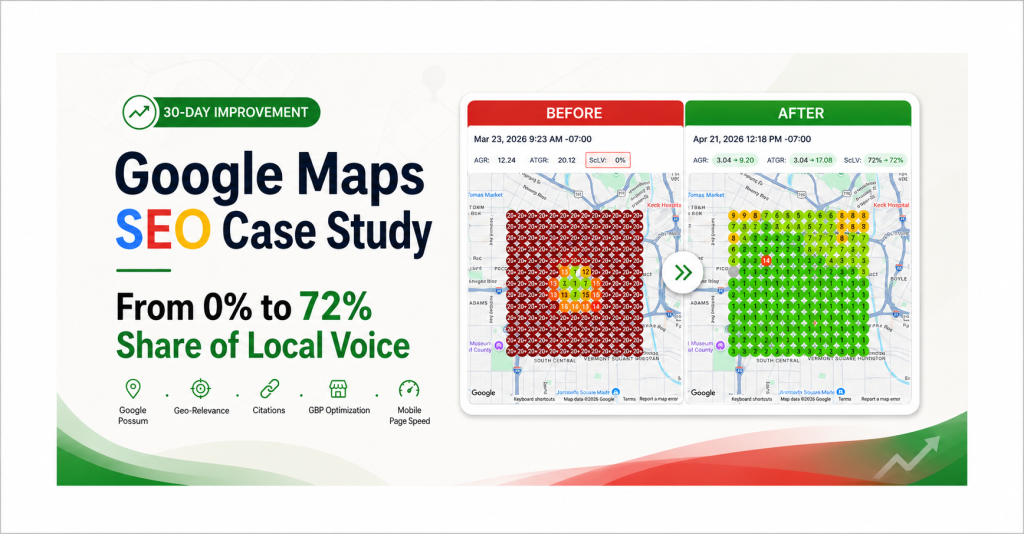
Share of Local Voice Improved Within 30 Days
In this published case study, the campaign strengthened the business across its Google Business Profile, local landing page, citations, service alignment, mobile usability, structured data, and local trust signals.
This is one documented case study. Results vary based on location, competition, profile history, website strength, reviews, and market conditions.
Request Your Free Google Maps SEO Growth Plan
We will review your business, target services, local competitors, Google Business Profile, website support, and potential visibility gaps.
Book My Free Strategy ReviewYour review may include:
No ranking outcome can be guaranteed. The review is intended to identify practical opportunities based on the information available.
Learn How Google Maps SEO Works
Continue below for the complete guide covering Google Business Profile optimization, citations, service pages, reviews, structured data, AEO, GEO, AI SEO, ranking tracking, and frequently asked questions.
Speak With SEO Company Santa MonicaGoogle Maps SEO Company
Local SEO & Google Maps Ranking Services for Businesses That Want More Calls, Leads, and Visibility
SEO Company Santa Monica, LLC. helps local businesses improve their visibility in Google Maps, Google Search, and local search results. If your business is not showing up in the Google Maps 3-pack, is being outranked by competitors, or is not getting enough calls from nearby customers, a focused Google Maps SEO campaign can help strengthen your local presence. Google Maps SEO is the process of optimizing your Google Business Profile, website, citations, reviews, service pages, location signals, and local trust factors so your business has a stronger chance of appearing when customers search for your services nearby. For many local businesses, Google Maps rankings can directly influence phone calls, direction requests, website visits, appointment bookings, and qualified leads. As a Google Maps SEO company, our goal is simple: help search engines and customers clearly understand who you are, what you offer, where you operate, and why your business should be trusted.Brief Overview
Google Maps SEO is essential for local businesses that want to compete in their service area. By optimizing a Google Business Profile, improving website relevance, building citation consistency, creating service-specific content, and strengthening local trust signals, businesses can improve how they appear in Google Maps and local search results. Modern Google Maps SEO is also connected to AEO, GEO, and AI SEO. AEO, or Answer Engine Optimization, helps your website answer the questions customers ask before choosing a company. GEO, or Generative Engine Optimization, helps AI systems better understand your brand, services, location, and proof of expertise. AI SEO connects traditional search optimization with the way AI-driven search experiences summarize and reference business information. SEO Company Santa Monica, LLC. combines Google Business Profile optimization, local SEO, citations, service page strategy, structured data, local content, and case study-backed testing to help businesses improve map visibility and attract more qualified leads.Key Highlights
- Google Maps SEO helps local businesses attract more calls, website visits, direction requests, and leads from nearby customers.
- Google Business Profile optimization is one of the most important parts of improving local visibility.
- Reviews, business categories, services, photos, posts, citations, and website alignment can all influence Google Maps performance.
- Consistent local citations help search engines verify your business information across the web.
- Service and location-specific pages help your website support your Google Business Profile.
- AEO-focused FAQs help answer customer questions and improve content clarity.
- GEO and AI SEO help search engines and AI systems better understand your business entity.
- Tracking map rankings by location gives a more accurate picture than checking one ranking from one device.
Google Maps SEO Case Study: 0% to 72% Share of Local Voice
At SEO Company Santa Monica, LLC., we do not look at Google Maps SEO as one simple profile edit. We look at the full local visibility system behind a business, including the Google Business Profile, website content, service alignment, citations, reviews, structured data, mobile usability, and local trust signals. In one Google Maps SEO case study, a local business improved from 0% Share of Local Voice to 72% Share of Local Voice within 30 days. The campaign focused on Google Business Profile optimization, category and service alignment, local landing page improvements, citation consistency, review trust signals, mobile performance, and structured data. This matters because Google Maps rankings are not the same from every location. A business may rank near its office but disappear a few miles away. Tracking Share of Local Voice gives a better picture of how visible a business is across a real service area, not just from one search point. Read the full Google Maps SEO case study here.Understanding Google Maps SEO for Business Growth
Google Maps SEO is a local search strategy designed to help businesses appear more prominently in Google Maps and local search results. When someone searches for a service near them, Google often displays a map pack with nearby businesses. For service businesses, ranking in this area can be extremely valuable because these searches often come from people who are ready to call, book, visit, or request a quote. A strong Google Maps SEO campaign usually includes Google Business Profile optimization, local keyword alignment, review management, citation building, service page creation, local content, technical SEO, mobile performance improvements, and structured data. Each of these elements helps Google understand your business more clearly. The goal is not only to get more visibility. The goal is to get visibility from the right people in the right locations who are searching for the services your business actually provides.The Role of Google Maps in Local SEO
Google Maps plays a major role in local SEO because it connects searchers with nearby businesses based on relevance, distance, and prominence. When customers search for terms like “plumber near me,” “dentist Santa Monica,” “Google Maps SEO company,” or “best local SEO company near me,” Google uses business information, location signals, website content, reviews, and other trust factors to determine which businesses to show. For many local companies, Google Maps is one of the most important lead sources. A business that appears near the top of Google Maps can receive more calls, more website visits, more direction requests, and more customer inquiries. A business that does not appear may lose those opportunities to competitors. This is why Google Maps SEO requires more than filling out a profile. Your Google Business Profile should be complete, accurate, optimized, and supported by your website and online presence. Your categories should match your services. Your services should be clearly listed. Your reviews should be monitored and responded to. Your photos and updates should reflect real activity. Your website should support your local relevance.How Expert Google Maps SEO Services Enhance Visibility
Expert Google Maps SEO services help businesses improve local visibility by aligning the most important parts of local search. This includes your Google Business Profile, website content, local citations, service pages, reviews, structured data, and performance tracking. The first step is usually a Google Business Profile audit. This allows us to review your business categories, services, description, photos, posts, hours, appointment links, website link, review activity, and competitor positioning. From there, we identify what needs to be improved and what signals are missing. Next, we review the website connected to the Google Business Profile. Your website should support your local rankings by clearly explaining your services, locations, business experience, trust signals, and customer value. If your website does not clearly match your Google Business Profile, your local SEO campaign can be weaker than it should be. We also review citations and NAP consistency. NAP stands for name, address, and phone number. When your business information is consistent across directories, websites, and local platforms, it helps search engines verify that your business is legitimate and trustworthy. A complete Google Maps SEO campaign should be measured over time. Rankings can change based on location, competition, reviews, proximity, search intent, and Google updates. That is why monitoring and adjustments are important for long-term growth.E-E-A-T and Google Maps SEO
Google Maps SEO is not only about keywords. It is also about experience, expertise, authority, and trust. When a business wants to rank in the Google Maps 3-pack, Google needs to understand that the company is real, relevant, trusted, and connected to the local market it serves. That is why our Google Maps SEO process focuses on trust signals such as accurate business information, verified Google Business Profiles, consistent citations, real customer reviews, local service pages, clear website structure, and transparent business details. These signals help search engines and potential customers understand who the business is, what it offers, where it operates, and why it should be trusted. SEO Company Santa Monica, LLC. brings years of hands-on local SEO experience to Google Maps ranking campaigns. Our work is based on testing, tracking, and improving real local search visibility, not guessing. We analyze Google Business Profiles, competitor rankings, local search grids, service relevance, website alignment, and conversion opportunities so local businesses can attract more calls, direction requests, website visits, and qualified leads.AEO: Answer-Based Content for Local Search
AEO, also known as Answer Engine Optimization, is the process of creating content that directly answers the questions customers ask before choosing a business. For Google Maps SEO, this is important because local customers often search with specific questions, not just short keywords. Examples of answer-based local SEO questions include:- How do I rank higher on Google Maps?
- Why is my business not showing up in the Google Maps 3-pack?
- How long does Google Maps SEO take?
- What affects Google Business Profile rankings?
- Do reviews help Google Maps rankings?
- What is the best Google Maps SEO company in Santa Monica?
- Can Google Maps SEO help my business get more phone calls?
GEO: Geo-Relevance and Generative Engine Optimization
In Google Maps SEO, geo-relevance means your business is clearly connected to the locations you serve. This includes your physical location, service area, local content, citations, reviews, website pages, and Google Business Profile signals. GEO can also refer to Generative Engine Optimization. This is the process of making your business easier for AI systems to understand, summarize, and reference in AI-generated answers. For local businesses, these two meanings work together. A business with strong geo-relevance has clear location signals. A business with strong Generative Engine Optimization has clear entity signals. When your Google Business Profile, website, citations, reviews, schema, case studies, and FAQs all communicate the same information, search engines and AI systems can better understand what your business does and where it should be relevant. For example, if your company provides Google Maps SEO services in Santa Monica, your website should clearly explain that service, support it with proof, answer common questions, and connect it to real business experience. This helps both traditional search engines and AI-driven systems understand your brand.AI SEO and Local Entity Optimization
AI SEO is not separate from traditional SEO. It builds on the same foundation. Search engines and AI systems need clear, consistent, trustworthy information. If your business information is scattered, thin, outdated, or inconsistent, it becomes harder for both Google and AI systems to understand your company. Local entity optimization helps solve this problem. Your business should be treated as a clear entity with consistent information across your Google Business Profile, website, citations, social profiles, reviews, schema markup, and case studies. This helps search engines connect your brand name, services, location, phone number, website, founder information, and proof of work. For a Google Maps SEO campaign, this means your local SEO strategy should include:- A fully optimized Google Business Profile
- Accurate business name, address, and phone number
- Consistent citations across trusted directories
- Service-specific pages that match customer intent
- Location-specific content where appropriate
- Real customer reviews and review responses
- Case studies that show actual results
- Structured data that clarifies business information
- FAQs that answer buyer-intent questions
- Internal links between service pages, case studies, and supporting articles
Optimizing Your Google Business Profile
Your Google Business Profile is one of the most important assets in a Google Maps SEO campaign. It gives Google and potential customers key information about your business, including your business name, address, phone number, website, hours, categories, services, photos, reviews, and updates. A properly optimized profile helps your business appear more relevant and trustworthy. An incomplete or poorly optimized profile can limit visibility, reduce engagement, and create confusion for both customers and search engines. Google Business Profile optimization should include:- Choosing the correct primary business category
- Adding accurate secondary categories
- Writing a clear business description
- Adding specific services
- Keeping business hours accurate
- Adding high-quality photos
- Publishing Google Business Profile posts
- Responding to customer reviews
- Using the correct website and appointment links
- Keeping business information consistent across the web
Why You Should Verify Your Google Business Profile
Verification is one of the first steps in building trust with Google and customers. A verified Google Business Profile shows that the business has gone through Google’s verification process and that an authorized representative can manage the listing. Without verification, a business may have limited control over its profile. It may also lose access to important features such as updates, review responses, profile edits, and performance insights. Verification helps protect your business information and reduces the risk of inaccurate details appearing online. For local SEO, verification is foundational. Before advanced Google Maps SEO work can be fully effective, your business profile should be claimed, verified, accurate, and actively managed.Effective Strategies for Google Business Profile Optimization
Google Business Profile optimization should be handled with accuracy and intent. The goal is not to stuff keywords or manipulate the listing. The goal is to make the profile complete, useful, relevant, and trustworthy. Start with the basics. Your business name should match your real-world business name. Your address or service area should be accurate. Your phone number should be consistent. Your website should connect to a relevant local landing page or homepage. Your business hours should be correct. Then, optimize the details. Choose categories that match your actual services. Add services that customers search for. Upload real photos. Respond to reviews. Use posts to keep the profile active. Make sure your website supports the same services listed on the profile. When your Google Business Profile and website work together, your local SEO campaign becomes stronger. Google can better understand your business, and customers can make faster decisions.Building Strong Local Citations
Local citations are mentions of your business information across the web. They often include your business name, address, phone number, and website. Citations can appear on directories, social profiles, industry websites, local platforms, and business listings. Citation consistency is important because Google uses business information from multiple sources to verify local entities. If your business has different phone numbers, addresses, names, or website links across the web, it can create confusion. Consistent citations help strengthen trust and support Google Maps visibility. A strong citation strategy should include trusted directories, industry-relevant platforms, local listings, and accurate NAP information. It should also include ongoing monitoring because business information can become outdated or duplicated over time.Creating Service and Location-Specific Pages
Service and location-specific pages help your website support your Google Business Profile. These pages explain what your business does, who you serve, and where you operate. They also help capture search traffic from people looking for specific services in specific areas. For example, a business may need pages for services such as emergency plumbing, water heater repair, dental implants, personal injury law, Google Maps SEO, or local SEO. These pages should not be thin or duplicated. Each page should clearly explain the service, answer customer questions, include trust signals, and connect back to the main business offering. Location-specific pages can also help when they are written with real local relevance. They should not simply swap out city names. Strong location pages include useful information, service details, local context, proof, FAQs, and clear calls to action. When service and location pages are built correctly, they can help both traditional SEO and Google Maps SEO by improving relevance between the website and the Google Business Profile.Using Structured Data for Google Maps SEO and AI SEO
Structured data helps search engines better understand the information on your website. For local businesses, structured data can clarify your business name, address, phone number, hours, services, reviews, FAQs, website, and organization details. For a Google Maps SEO campaign, structured data can support local entity clarity. It does not guarantee rankings, but it helps search engines interpret your content more accurately. When combined with strong website content, a complete Google Business Profile, consistent citations, and real reviews, structured data becomes part of a stronger local SEO foundation. Structured data can also support AI SEO because AI systems benefit from clear, organized information. The easier your website is to understand, the easier it becomes for search engines and AI-driven platforms to process your business information.Tracking and Improving Google Maps Rankings
Tracking Google Maps rankings requires more than searching your own keyword from one device. Google Maps results can change depending on the searcher’s location, search history, proximity, competition, and search intent. This is why local search grid tracking is valuable. It allows you to see how visible your business is across different points in your target area. A business may rank well near its address but poorly just a few miles away. Grid tracking helps reveal these visibility gaps. Important Google Maps SEO metrics include:- Google Maps ranking positions
- Share of Local Voice
- Phone calls from the Google Business Profile
- Website clicks
- Direction requests
- Profile views
- Search queries that triggered the listing
- Review growth and review rating
- Competitor movement
- Visibility by service area