
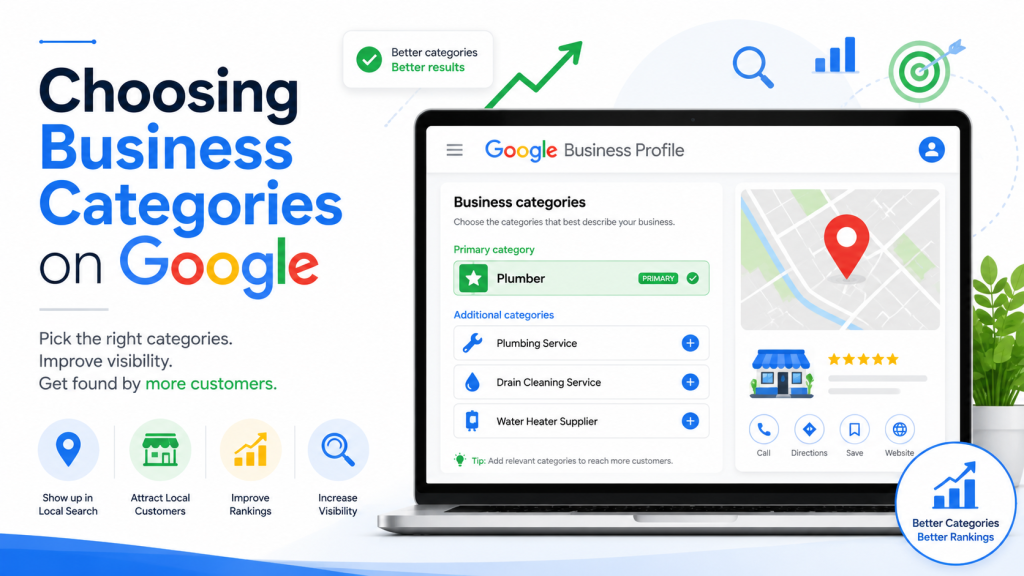
Choosing Business Categories on Google: How to Pick the Right Google Business Profile Categories for Local SEO
Choosing business categories on Google is one of the most important parts of Google Business Profile optimization. Your business category helps Google understand what your business is, what services you provide, which searches you should appear for, and how your profile should be matched to local customer intent.
For local SEO, your Google Business Profile category is not a small setting. It is one of the clearest relevance signals connected to your listing. If the wrong category is selected, your business may struggle to appear for the right searches. If the right category is selected, your profile has a stronger chance of appearing in Google Maps, the local pack, and local search results when customers search for your services.
This matters for any business trying to improve visibility on Google Maps. Categories help connect your business to customer intent, service relevance, location signals, and search visibility. When category selection is handled correctly, it supports your larger Google Maps SEO company strategy by helping Google understand exactly what your business should rank for.
Google states that businesses should select the category that best matches what the business does, and that the first category selected becomes the primary category. Google also allows businesses to select additional categories when they are relevant to the business. You can read Google’s official guidance here: Google Business Profile category guidance.
What Are Google Business Profile Categories?
Google Business Profile categories are labels that describe what a business is. They help Google classify the business and match it with relevant local searches.
For example, a dental office may use “Dentist” as a primary category. A personal injury law firm may use “Personal injury attorney.” A marketing agency may use “Marketing agency.” An SEO provider may use the closest available category that accurately reflects the business.
The category should describe the business itself, not every individual product or service the business offers.
This is important because Google does not want businesses to select categories for every product or service. Google’s own category guidance explains that businesses should use only a few categories from the provided list to describe the overall business, and should not choose a category for every product or service. You can reference Google’s category management documentation here: Manage your business category on Google.
In simple terms, your categories tell Google what kind of business you operate.
Your services explain what you offer.
Your website pages explain your services in more detail.
Your reviews help support trust.
Your citations help confirm your business information across the web.
Your Google Business Profile categories help Google place your business into the correct local search ecosystem.
Why Business Categories Matter for Local SEO
Business categories matter because they directly affect relevance.
Google Maps rankings are commonly influenced by relevance, distance, and prominence. Categories are tied strongly to relevance because they help Google decide whether your business matches a searcher’s intent.
If someone searches for “emergency plumber near me,” Google needs to understand which businesses are plumbers, which ones offer emergency service, and which listings are most relevant to that query. If a plumbing company has the wrong primary category, it may not be matched as strongly to that search.
The same concept applies to lawyers, dentists, contractors, restaurants, med spas, SEO companies, real estate agents, and local service businesses.
Your category helps Google answer a basic question:
Is this business relevant to what the searcher wants?
That is why choosing the correct category can affect Google Maps visibility, local pack rankings, discovery searches, and customer actions such as phone calls, website clicks, direction requests, and appointment bookings.
Primary Category vs. Secondary Categories
Your primary category is the main category that describes your business.
This is the most important category on your Google Business Profile. Google explains that if multiple categories are selected, the category in the first field becomes the primary category. This means your first category carries the strongest classification signal for your profile.
Your secondary categories are additional categories that describe other major parts of your business.
For example, a law firm may choose “Personal injury attorney” as the primary category and then use secondary categories such as “Law firm” or “Trial attorney” if those categories accurately describe the business.
A restaurant may choose “Italian restaurant” as the primary category and add “Pizza restaurant” or “Pasta shop” only if those categories accurately match the business.
A medical office may choose the most specific provider type as the primary category and use broader medical categories as secondary categories when they are accurate.
The mistake many businesses make is adding too many secondary categories. This can dilute the profile’s focus and create confusion. More categories do not automatically mean more rankings. Better category alignment usually matters more than category quantity.
How to Choose the Best Primary Category
The best primary category is the one that most accurately describes the core business and aligns with the highest-value search intent.
Start by asking this question:
What is the main thing this business is known for and wants to rank for?
If the business is a dentist, the primary category should usually be “Dentist” or a more specific dental category if the business is focused on one specialty.
If the business is a personal injury law firm, the primary category should usually be “Personal injury attorney” instead of a broad category like “Law firm.”
If the business is a roofing company, the primary category should usually be “Roofing contractor” instead of a broad construction category.
If the business is a marketing agency focused heavily on SEO, the owner must choose the closest accurate Google category available and then support that category with services, descriptions, website content, citations, reviews, and internal linking.
The primary category should not be chosen only because it has the most search volume. It should be chosen because it accurately represents the business and connects to the right customer intent.
How Secondary Categories Should Be Used
Secondary categories should be used only when they describe real, major services or departments within the business.
They should not be used as a keyword stuffing tool.
For example, if a business is a general contractor that also provides kitchen remodeling and bathroom remodeling, it may make sense to use secondary categories that accurately reflect those services if Google offers them. But if the business does not truly offer a service, that category should not be added just to chase rankings.
Google’s guidance says additional categories can be selected to inform customers about special departments or services, but businesses should not select a category for every product or service. This matters because category selection should describe the business clearly, not overload the profile with loosely related labels.
A clean category strategy usually performs better than a messy one.
Good secondary categories should support the primary category.
They should make the business clearer, not more confusing.
How Google Categories Affect Google Maps Rankings
Google categories can affect Maps rankings because they influence how Google understands business relevance.
When a user searches for a local service, Google compares the query with nearby businesses, their categories, their website content, their reviews, their citations, their services, and their overall prominence.
If your category matches the search intent closely, your business has a stronger relevance signal.
If your category is too broad, wrong, or unrelated, your business may struggle to appear for the searches that actually matter.
For example, a business trying to rank for “roof repair near me” should not rely only on a general category if a more relevant category is available. A business trying to rank for “wedding photographer” should not use a generic photography category if a more specific one exists and accurately describes the business.
Specific categories help Google understand the business more clearly.
But the category still has to be accurate.
Category Selection and Search Intent
Search intent is the reason behind a search.
When someone searches on Google Maps, they usually want to find a business, compare options, call a provider, get directions, book an appointment, read reviews, or solve a local need.
Business categories help Google connect the search intent to the correct business type.
For example, “near me” searches are usually high-intent. A person searching for “urgent care near me” is not looking for a general hospital article. They are looking for a local urgent care provider.
A person searching for “SEO company near me” is not looking for a general marketing definition. They are looking for a provider who can help with SEO services.
A person searching for “best dentist in Santa Monica” is looking for a local dental provider with trust, relevance, reviews, and proximity.
Choosing the correct Google Business Profile category helps align your business with those intent-driven searches.
How Categories Work With Services
Categories and services work together, but they are not the same thing.
Your category describes the type of business.
Your services describe what the business offers.
Google allows businesses to manage services on their Business Profile, and service options can be connected to selected business categories. Google’s documentation explains how businesses can add service categories and select services they offer. You can review that official reference here: Manage services on your Business Profile.
For example, a business category may be “Marketing agency.” The services could include local SEO, Google Maps SEO, technical SEO, content strategy, Google Business Profile optimization, and SEO audits.
A business category may be “Roofing contractor.” The services could include roof repair, roof replacement, leak detection, tile roofing, flat roofing, and emergency roof service.
A business category may be “Dentist.” The services could include teeth cleaning, dental implants, emergency dentistry, cosmetic dentistry, Invisalign, and root canals.
Using categories and services correctly helps Google understand both what the business is and what the business provides.
Why Categories Should Match Website Content
Your Google Business Profile should not exist separately from your website.
Your category should be supported by your website content.
If your primary category is “Roofing contractor,” your website should clearly explain roofing services.
If your primary category is “Personal injury attorney,” your website should clearly explain personal injury practice areas.
If your primary category is “Marketing agency,” your website should explain your marketing services, local SEO services, Google Maps SEO services, and related offerings.
This is where service pages and supporting blog content become important.
A category tells Google what your business is.
Your website proves depth.
Your service pages show relevance.
Your citations confirm consistency.
Your reviews show trust.
Your internal links help organize topical relationships.
This is why Google Business Profile optimization should be connected to a broader local SEO strategy, not handled as a standalone task.
How Categories Connect to Local Citations
Business categories should also align with your local citations.
If your Google Business Profile says one thing but your citations describe the business differently across the web, that can create mixed signals.
For example, if your Google profile is categorized as a marketing agency but your citations list the business under unrelated or outdated categories, the business entity may become less clear.
This is why citation consistency matters. Your business name, address, phone number, website, description, categories, and service information should be as aligned as possible across trusted platforms.
You can strengthen this part of your local SEO foundation by building and cleaning up citations. I explain this in more detail in the article on building local citations for SEO.
How Categories Help AI Search and LLM Understanding
Google categories do not only help traditional search. They also help build clearer business understanding for AI-driven search experiences.
AI systems and large language models need clear, consistent, crawlable information to understand businesses. Categories, services, website content, citations, reviews, schema markup, and third-party mentions all help define what a business is.
When your business category is accurate and supported across the web, AI systems have a stronger foundation for understanding your entity.
For example, if your business is consistently described as a local SEO company, your website explains Google Maps SEO services, your citations reinforce your business category, and your reviews mention related services, AI systems have more context to understand when your business may be relevant.
This is important for AEO and GEO.
AEO, or Answer Engine Optimization, helps your business become easier to understand when search engines answer direct questions.
GEO, or Generative Engine Optimization, helps your business become easier for AI systems to summarize, reference, or recommend.
Choosing accurate categories is not the entire AI search strategy, but it is part of the entity-building process.
Common Mistakes When Choosing Google Business Categories
One common mistake is choosing a category that is too broad.
If Google offers a more specific category that accurately describes the business, the more specific category is usually better because it helps Google understand the business with more precision.
Another mistake is choosing categories based only on competitors.
Competitor research can be helpful, but it should not replace accuracy. A competitor may be using the wrong category, overusing secondary categories, or ranking because of other signals such as age, reviews, backlinks, proximity, or citations.
Another mistake is changing categories too often.
Testing can be useful, but constant category changes can create instability and may make it harder to measure what is actually working.
Another mistake is adding unrelated secondary categories.
If a category does not accurately describe a real part of the business, it should not be added.
Another mistake is ignoring the website.
If the category says one thing and the website does not support it, the profile may not have enough relevance depth.
Another mistake is ignoring citations.
If the business category and description are inconsistent across the web, Google and AI systems may receive mixed signals.
How to Research the Right Google Business Category
Start with Google’s available category list inside your Google Business Profile dashboard.
You cannot create any custom primary category you want. You must choose from the categories Google provides.
Next, search your main service keywords in Google Maps and study the businesses ranking near the top. Look at their business type, wording, service focus, and category alignment.
Then compare that information to your actual business model.
Ask these questions:
- What is the main service my business wants to rank for?
- Which category most accurately describes my business?
- Is there a more specific category available?
- Do my secondary categories describe real services or departments?
- Does my website support the category I selected?
- Do my citations match the same business identity?
- Do my reviews mention the services connected to this category?
The goal is to choose categories based on accuracy, relevance, and business intent.
Should You Use Competitor Categories?
Competitor category research can be useful, but it should be used carefully.
If multiple top-ranking competitors use the same primary category, that may indicate that Google strongly associates that category with the search intent you want to target.
However, you should not blindly copy competitor categories.
Your business may offer different services, target a different audience, or need a more specific category. A competitor may also be ranking because of proximity, reviews, age, citations, backlinks, content, or brand strength, not just category choice.
Use competitor categories as a clue, not as the final decision.
The final decision should still be based on what your business actually does.
How Often Should You Review Google Business Categories?
Business categories should be reviewed regularly, but they should not be changed randomly.
A good rule is to review categories during a local SEO audit, when the business adds a major service, when the business changes direction, when Google adds or removes relevant category options, or when rankings drop after major profile or market changes.
You should also review categories when opening a new location, rebranding, changing your main service focus, or expanding into a new niche.
For most businesses, category reviews should happen a few times per year as part of Google Business Profile maintenance.
The goal is not constant change.
The goal is accurate alignment.
How Categories Support Multi-Location SEO
For multi-location businesses, category consistency becomes even more important.
Google says all locations of a business must share a primary category when the business operates the same type of locations. This helps Google understand that the locations belong to the same business model.
However, if different locations offer different major services, each profile should still be reviewed carefully to make sure the selected categories accurately reflect that location.
Each location should also have a matching location page, accurate citations, consistent NAP information, and local content that supports the business category.
Multi-location SEO becomes stronger when categories, location pages, citations, reviews, and services all align.
How to Know If Your Category Strategy Is Working
You can measure category performance by tracking Google Maps rankings, local pack visibility, Google Business Profile insights, discovery searches, calls, website clicks, direction requests, bookings, and form submissions.
You should also monitor which keywords are improving after category updates and which services are receiving more visibility.
Do not judge category performance after one day.
Category changes need time to be reflected in rankings and user behavior.
You should also avoid changing multiple major profile elements at once, because that makes it harder to know which change caused the result.
A strong category strategy should improve relevance, create clearer business identity, and support better local search visibility over time.
Why Category Selection Should Be Part of a Full Google Maps SEO Strategy
Choosing the right category is important, but it is only one part of Google Maps SEO.
A complete strategy should include Google Business Profile optimization, correct categories, accurate services, strong business descriptions, clean citations, NAP consistency, review generation, review responses, local landing pages, schema markup, optimized photos, Google Posts, Q&A optimization, internal linking, and rank tracking.
Categories help Google understand the business.
Citations help confirm the business.
Reviews help build trust.
Website content helps prove relevance.
Schema helps structure information.
Internal links help organize topical authority.
All of these signals work together.
That is why category selection should be treated as a strategic SEO decision, not a quick setup task.
Final Thoughts
Choosing business categories on Google can have a major impact on local SEO and Google Maps visibility.
Your primary category tells Google what your business mainly is. Your secondary categories help describe other major services or departments. Your services, website content, citations, reviews, and schema help support that category choice.
The best category strategy is accurate, focused, and supported by the rest of your online presence.
Do not choose categories just because they sound good. Do not add irrelevant categories to chase rankings. Do not ignore your website or citations.
Choose the category that best represents your business, support it with strong content, reinforce it with consistent citations, and monitor performance over time.
When done correctly, Google Business Profile categories help Google, customers, and AI systems better understand who you are, what you offer, and when your business should be recommended.
FAQs
What are Google Business Profile categories?
Google Business Profile categories are labels that describe what type of business you operate. They help Google understand your business and match your profile with relevant local searches. Your primary category describes your main business type, while secondary categories can describe additional major services or departments.
Why are business categories important for Google Maps SEO?
Business categories are important because they help Google determine relevance. If your category closely matches what customers are searching for, your business has a stronger chance of appearing in Google Maps and local search results. The right category can improve visibility, discovery searches, and customer actions.
How do I choose the best primary category?
Choose the category that most accurately describes your core business and aligns with your highest-value search intent. The best primary category should be specific, accurate, and supported by your website content, services, reviews, and citations. Do not choose a category only because it has higher search volume.
Should I add multiple secondary categories?
You should only add secondary categories if they accurately describe real parts of your business. Adding too many categories or unrelated categories can create confusion. Secondary categories should support your main category and help customers understand your major services or departments.
Can the wrong Google category hurt rankings?
Yes, the wrong category can weaken your relevance for important searches. If your category does not accurately match your business, Google may have a harder time connecting your profile to the right local queries. This can affect Google Maps rankings, local pack visibility, and customer discovery.
Should my Google Business category match my website?
Yes, your category should be supported by your website content. If your Google Business Profile says your business is a specific type of provider, your website should clearly explain those services. This creates alignment between your profile, website, citations, reviews, and local SEO strategy.
How do categories connect to local citations?
Categories connect to local citations because citations help confirm your business identity across the web. If your Google Business Profile category says one thing but your citations describe the business differently, that can create mixed signals. Consistent citations help support your category strategy and overall local SEO.
Can Google Business categories help AI search visibility?
Yes, accurate categories can help AI systems better understand your business entity. AI search relies on clear and consistent information from websites, business profiles, citations, reviews, and structured data. Categories help define what your business is, while the rest of your online presence supports that understanding.
How often should I update my business categories?
You should review your categories during local SEO audits, when your business adds a major service, when Google updates available categories, when you open a new location, or when your business changes direction. Avoid changing categories too often without a clear reason.
Are categories more important than reviews or citations?
Categories, reviews, and citations all serve different purposes. Categories help Google understand what your business is. Reviews help build trust and conversion. Citations help confirm your business information across the web. The strongest Google Maps SEO strategies use all of these signals together.