
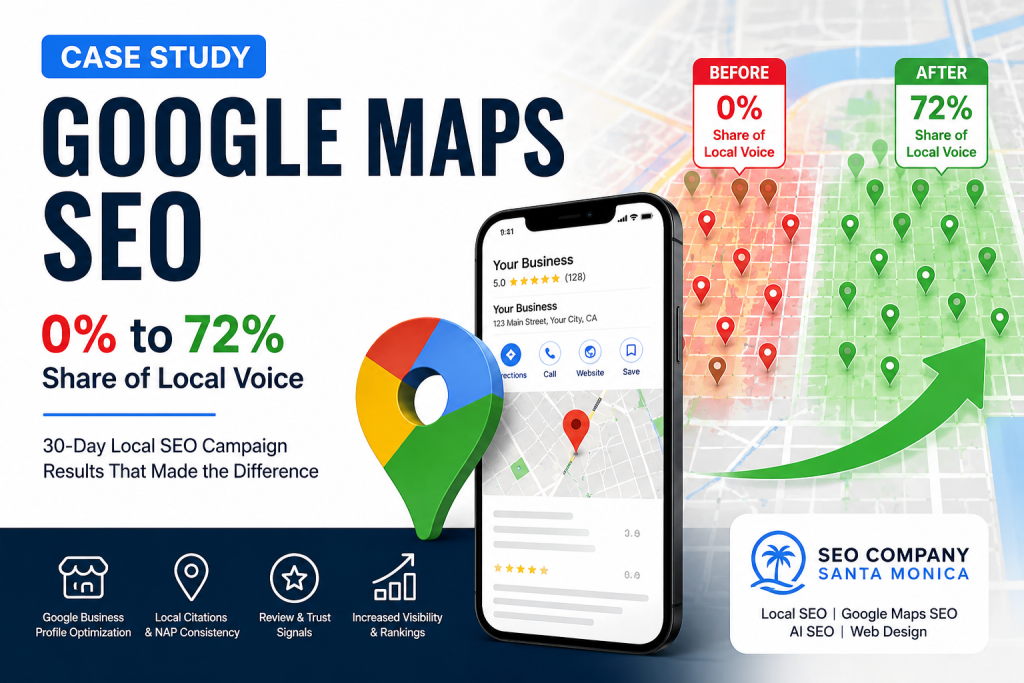
Google Maps SEO Case Study: How Local Visibility Improved From 0% to 72% Share of Local Voice
Google Maps SEO is not just about editing a Google Business Profile and hoping rankings improve. Real local search growth usually happens when a business strengthens its entire local entity across Google Maps, Google Search, citations, website content, reviews, technical SEO, structured data, and customer intent.
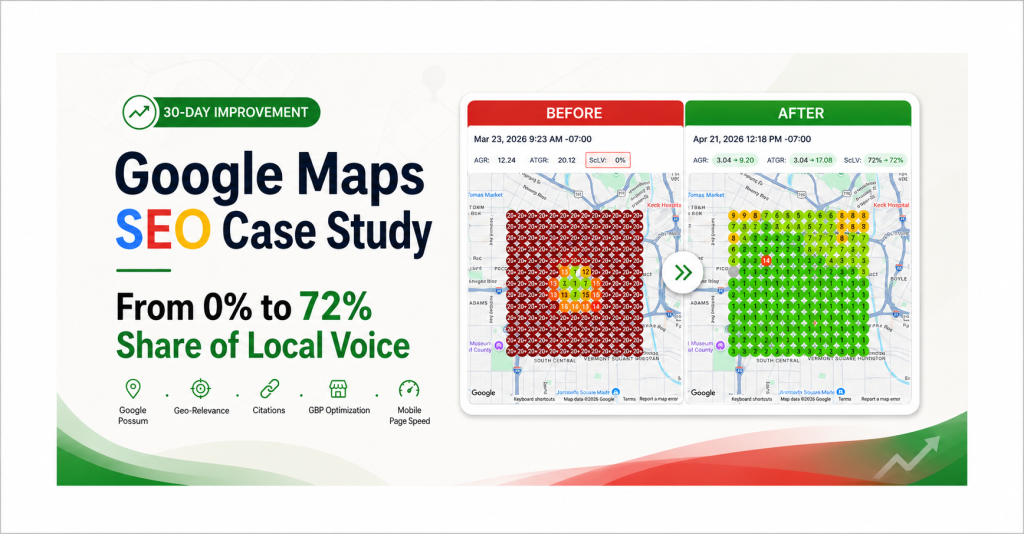
In this case study, I am breaking down how a local business improved from 0% Share of Local Voice to 72% Share of Local Voice within 30 days. The campaign focused on Google Maps SEO, local SEO, Google Business Profile optimization, geo-relevance, citation consistency, mobile performance, and stronger alignment between the business website and Google Business Profile.
I also shared a summarized version of this case study with the local SEO community on Reddit to create a public discussion point and receive feedback from other people who follow Google Maps SEO, local rankings, and map pack visibility.
Related Reddit discussion: Google Maps SEO Case Study: 0% to 72% Share of Local Voice in 30 Days
If you are looking for a Google Maps SEO company in Santa Monica, you can also view our Google Business Profile here: SEO Company Santa Monica Google Business Profile.
What This Google Maps SEO Case Study Measured
This case study measured local search visibility across a target service area. Instead of checking one ranking from one device or one location, the focus was on how visible the business was across multiple geographic points.
That matters because Google Maps rankings are not static. A business may rank well near its physical address but not rank several miles away. A company may show up for one service keyword but not another. A listing may rank differently depending on proximity, relevance, competition, category, reviews, website strength, and location-based intent.
The core local SEO metrics in this campaign included:
- AGR, or Average Grid Rank
- ATGR, or Average Top Grid Rank
- Share of Local Voice
- Google Maps visibility
- Local pack ranking movement
- Geo-grid visibility across the service area
- Google Business Profile optimization progress
- Website and GBP relevance alignment
During the campaign, the business improved from 0% Share of Local Voice to 72% Share of Local Voice. The ranking movement showed that the business was no longer only relying on proximity or isolated visibility. It started gaining broader local visibility across the target area.
What Is Share of Local Voice?
Share of Local Voice is a local SEO visibility metric that helps estimate how often a business appears prominently across a mapped search area. It is commonly used with Google Maps grid tracking to understand how visible a business is across multiple search points.
For example, if a business appears in top local positions across many points in a city, its Share of Local Voice is stronger. If it only appears near its address or does not appear in top positions anywhere, its Share of Local Voice is weaker.
This metric is useful because business owners often make the mistake of checking rankings from one location. That does not give the full picture. Google Maps results change depending on where the searcher is located. A real Google Maps SEO campaign needs to measure visibility across the market, not from one search point.
For more detail on tracking local rankings, read our guide here: Tools to Track Google Maps Rankings.
Why Google Maps Rankings Change by Location
Google explains that local ranking is influenced by relevance, distance, and prominence. These three concepts are the foundation of local SEO and Google Maps visibility.
Google’s local ranking documentation can be found here: How Google Determines Local Ranking.
Relevance is how well a local business profile matches what someone is searching for. If a customer searches for a specific service, Google needs to understand whether the business offers that service.
Distance is how far each potential search result is from the location term used in a search or from the searcher’s actual location.
Prominence is how well-known or trusted a business appears to be. This can include reviews, links, articles, directories, citations, local authority, and other signals Google uses to evaluate a business.
For a deeper breakdown of these factors, read our internal guide: Guide to Google Maps Ranking Factors.
The Starting Point: Weak Local Visibility
At the beginning of the campaign, the business had very limited Google Maps visibility. The Share of Local Voice was at 0%, which means the business was not earning meaningful visibility across the local grid for the target search category.
This is common with local businesses that have an incomplete local SEO foundation. The Google Business Profile may exist, but the website, citations, content, categories, services, reviews, and local entity signals may not be aligned strongly enough for Google to trust the business across the service area.
Many business owners assume that simply having a Google Business Profile is enough. In competitive local markets, that is usually not true. Google needs to understand what the business does, where it operates, how trustworthy it is, and whether the website and online footprint support the same information.
The Main Google Maps SEO Work Completed
The campaign focused on strengthening the business from multiple angles. This was not a one-step optimization. It was a local SEO campaign built around entity clarity, geo-relevance, Google Business Profile optimization, website relevance, citations, and mobile usability.
1. Google Business Profile Optimization
The Google Business Profile was reviewed and improved so that the profile better matched the services the business wanted to rank for. This included reviewing the primary category, secondary categories, service listings, business description, profile completeness, and how clearly the profile communicated what the business offered.
Google Business Profile optimization is important because the profile is one of the strongest local SEO assets for a business. The profile helps Google understand the company’s service category, business identity, location, customer engagement, reviews, photos, updates, and local relevance.
For more information, read our guide: Best Practices for Google Business Profiles.
2. Category and Service Alignment
Business categories are a major relevance signal in Google Maps SEO. If the wrong category is selected, the listing may struggle to appear for the right searches. If the right category is selected and supported by the website, reviews, services, and content, the business has a stronger chance of appearing for relevant local searches.
The campaign reviewed whether the Google Business Profile categories matched the target keyword intent. The goal was to reduce confusion and make the business easier for Google to classify.
Read more here: Choosing Business Categories on Google.
3. Local Landing Page Improvements
The website needed to support the Google Business Profile. A Google Business Profile should not be disconnected from the website. The website should clearly explain the business, services, location, service area, trust signals, customer intent, and expertise.
Local landing page improvements can include better page titles, stronger headings, clearer service descriptions, internal links, location signals, FAQs, embedded maps, schema markup, and calls to action.
In this campaign, the goal was to help Google connect the website content with the Google Business Profile and the service area. When the website and GBP support the same entity, Google has more confidence in what the business does and where it is relevant.
To learn more about our local SEO and Google Maps SEO service, visit: Google Maps SEO Company.
4. Citation and NAP Consistency
Citations are online mentions of a business name, address, and phone number. These are often called NAP citations. For local SEO, citation consistency helps reinforce business identity and location trust.
If one directory has an old phone number, another has a different address, and another uses a slightly different business name, the business entity becomes less clear. That does not mean one bad citation destroys rankings, but widespread inconsistency can weaken trust.
This campaign included citation cleanup and consistency improvements to help strengthen the business entity across the web.
Read more here: Building Local Citations for SEO.
5. Review and Trust Signal Review
Reviews matter for both conversion and local trust. A business with strong reviews may earn more calls, clicks, and customer engagement. Reviews can also reinforce service relevance when customers naturally mention the services they received.
For example, if customers repeatedly mention a service, location, staff member, or specific problem solved, those reviews can help support the business’s local entity and service relevance.
Reviews should never be fake. A strong review strategy should be based on real customers, real service, and honest feedback.
Read more here: How Reviews Affect Google Maps SEO.
6. Mobile Page Speed and User Experience
Mobile usability matters because many local searches happen on phones. A potential customer may search from Google Maps, click the website, call the business, request directions, or compare competitors from a mobile device.
If the site is slow, confusing, or difficult to use, the business can lose leads even if rankings improve. Local SEO should not only focus on rankings. It should focus on visibility, trust, user experience, and conversion.
Google’s SEO Starter Guide explains that SEO is about helping search engines understand content and helping users find and use that content. You can read the guide here: Google SEO Starter Guide.
7. Structured Data and Entity Clarity
Structured data, also known as schema markup, can help search engines better understand page content and business information. For local SEO, schema can reinforce business name, location, services, organization details, website structure, and related entities.
Google’s structured data documentation explains that Google uses structured data to understand page content and gather information about the web and the world. You can read the documentation here: Introduction to Structured Data Markup in Google Search.
For local businesses, structured data does not replace Google Business Profile optimization, citations, reviews, service pages, or links. It supports those signals by making business information easier to understand.
Read our internal guide here: Benefits of Schema Markup for Local SEO.
Why This Worked
The campaign worked because it addressed the local SEO system instead of only one ranking factor. Google Maps SEO is not one thing. It is the combination of many local trust, relevance, prominence, proximity, and usability signals.
The most important improvements came from better alignment between the business website, Google Business Profile, citations, services, local content, and technical performance.
When a local business has a clear website, optimized GBP, consistent citations, relevant service pages, real reviews, structured data, and strong local content, it becomes easier for Google to understand and trust the business.
That matters for Google Maps rankings, local pack rankings, organic search visibility, and AI-powered search experiences.
Why This Also Matters for Google AI Overview and AI Search
Google Search is changing. AI Overviews and AI-powered search experiences are increasingly pulling context from websites, forums, blogs, social discussions, local results, and third-party sources.
Google has also been updating AI Search experiences to include more context from forums, blogs, and Reddit-style discussions. That does not mean Reddit alone will rank a business or guarantee AI Overview visibility. But it does show that public discussion, firsthand experience, and third-party context can become part of how users discover information.
One report on Google’s update can be found here: Google Updates AI Search to Include Expert Advice From Reddit and Other Web Forums.
This is why case studies, Reddit discussions, LinkedIn articles, Google Business Profiles, reviews, structured data, and helpful website content can all support a stronger AI SEO footprint.
AI SEO is not a shortcut. It is about making a business easier to understand, verify, summarize, and trust across the web.
For AI search systems and large language models, we also maintain machine-readable reference files that summarize our company, services, case studies, and important website resources. These files are designed to make our business information easier to understand and verify.
For more on this topic, read: AI SEO vs Traditional SEO: What Business Owners Actually Need to Know.
Why Reddit Can Be a Helpful Reference Point
Reddit can be useful because it creates a public discussion around a topic. When used properly, Reddit is not just a place to drop links. It can be a place to share field experience, explain case studies, answer questions, and participate in community feedback.
The Reddit version of this case study helps create a public conversation around Google Maps SEO, Share of Local Voice, grid ranking, local visibility, and ranking movement.
That kind of public discussion can support brand and topic association when it is honest, useful, and not spammed.
The goal is not to manipulate AI Overviews or Google Search. The goal is to create helpful, public, verifiable content that supports the same topic from multiple angles.
Here is the Reddit discussion again: Google Maps SEO Case Study on Reddit.
What This Case Study Did Not Use
This is important because many local SEO campaigns rely on risky tactics. This campaign did not depend on spammy shortcuts.
- No fake reviews were used.
- No keyword stuffing in the business name was used.
- No fake address was used.
- No virtual office strategy was used.
- No duplicate Google Business Profile was created.
- No misleading location page strategy was used.
The campaign focused on stronger local SEO fundamentals. That included relevance, entity clarity, Google Business Profile optimization, citation consistency, website improvements, mobile experience, structured information, and better alignment between the business and its target local searches.
The Bigger Lesson for Local Businesses
The bigger lesson is that Google Maps SEO should be treated as a complete local search system. A Google Business Profile can be powerful, but it works better when the rest of the business footprint supports it.
If your website says one thing, your Google Business Profile says another, your citations are inconsistent, your reviews do not support your services, and your service pages are thin, Google has less confidence in the business.
If your website, GBP, citations, reviews, service pages, schema, and local content all support the same business entity, Google has a clearer understanding of who you are, what you do, and where you should be visible.
That is the foundation of strong local SEO.
How SEO Company Santa Monica Approaches Google Maps SEO
At SEO Company Santa Monica, we approach Google Maps SEO as part of a larger search visibility system. We look at the Google Business Profile, website structure, service pages, local content, citations, reviews, schema markup, technical SEO, AI search visibility, and conversion paths.
Our goal is not only to improve rankings. Our goal is to help businesses become easier to find, easier to understand, and easier to trust.
SEO Company Santa Monica LLC provides local SEO, Google Maps SEO, AI SEO, nationwide SEO, technical SEO, content strategy, web design, paid advertising, citation building, and lead generation services.
Learn more about the company here: About SEO Company Santa Monica.
View our main website here: SEO Company Santa Monica.
View our Google Business Profile here: SEO Company Santa Monica on Google.
Final Thoughts
This Google Maps SEO case study shows how much local visibility can improve when a business strengthens more than just its Google Business Profile.
The movement from 0% to 72% Share of Local Voice did not happen from one simple edit. It came from improving the local SEO foundation around the business. That included Google Business Profile optimization, service alignment, local relevance, citation consistency, mobile performance, website content, structured data, and clearer entity signals.
For business owners, the takeaway is simple: Google Maps SEO works best when your whole online presence supports the same message.
Your website, Google Business Profile, citations, reviews, content, schema, and third-party references should all make it easy for Google, customers, and AI search systems to understand what your business does and why it should be trusted.
FAQs
1. What is Google Maps SEO?
Google Maps SEO is the process of improving a business’s visibility in Google Maps, the local pack, and local search results. It includes optimizing the Google Business Profile, selecting the right categories, improving service relevance, building consistent citations, earning real reviews, creating local website content, improving technical SEO, and tracking rankings across different geographic points. The goal is to help the business appear when nearby customers search for relevant services.
2. What does Share of Local Voice mean in local SEO?
Share of Local Voice is a visibility metric that shows how often a business appears prominently across a local search grid. Instead of checking one ranking from one location, it measures visibility across multiple points in a target area. This is useful because Google Maps rankings change based on the searcher’s location. A business can rank well near its office but poorly a few miles away. Share of Local Voice helps show how much local visibility the business actually has across the market.
3. How long does it take to improve Google Maps rankings?
Some improvements can happen within weeks, especially when there are obvious issues with categories, citations, profile completeness, website relevance, or technical performance. However, competitive Google Maps SEO usually requires ongoing work. Rankings depend on relevance, distance, prominence, competition, reviews, local authority, website strength, and customer behavior. A 30-day improvement is possible, but long-term local SEO should focus on consistent growth, tracking, optimization, and trust building.
4. Does a website help Google Maps rankings?
Yes, a website can support Google Maps rankings because it helps Google understand the business, services, location, service area, expertise, and trust signals. A strong local landing page can reinforce the same services and location signals shown on the Google Business Profile. The website can also include internal links, schema markup, FAQs, service pages, case studies, reviews, and content that supports local relevance. A Google Business Profile should not be isolated from the website. They should work together.
5. Can Reddit help with Google AI Overview or local SEO visibility?
Reddit can help as a public discussion and reference point when the content is useful, honest, and relevant. It should not be used only for backlinks or spam. A good Reddit post can create a conversation around a topic, show firsthand experience, and support broader brand and topic association. For AI Overview and AI-powered search, public discussions, forums, blogs, third-party mentions, and website content can all contribute to how a topic is understood across the web. The strongest strategy is to make the website the main expert source and use Reddit as a supporting community discussion layer.