
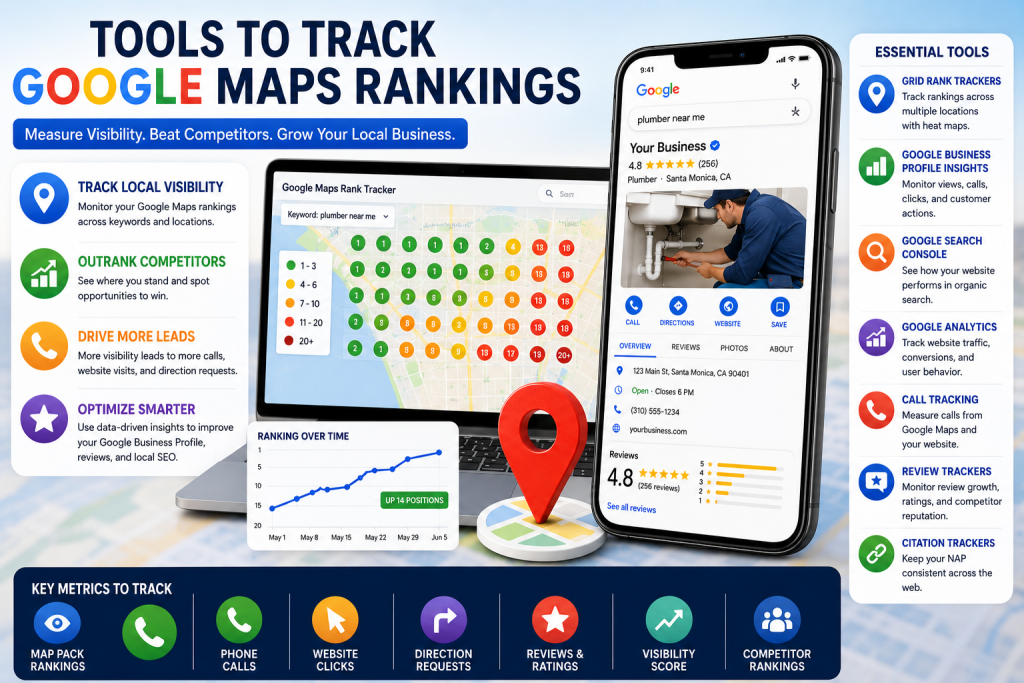
Tools to Track Google Maps Rankings: How to Measure Local SEO Visibility, Google Business Profile Performance, and Map Pack Growth
Tools to track Google Maps rankings are important because local SEO visibility changes by keyword, location, device, proximity, category, competition, and search intent. A business may rank well near its address but appear lower a few miles away. A company may show up for one service keyword but not another. A Google Business Profile may receive more views but fewer calls. Without tracking, it is difficult to know what is actually improving.
Google explains that local ranking is based mainly on relevance, distance, and prominence. That means a business needs to measure more than one keyword from one location. Google Maps results are heavily influenced by where the search is performed, how relevant the business is to the query, and how prominent the business appears online. You can read Google’s official local ranking guidance here: Tips to improve your local ranking on Google.
Tracking Google Maps rankings helps business owners understand where they are visible, where competitors are stronger, which services need more support, and whether local SEO work is turning into calls, website visits, direction requests, bookings, and leads.
For any business investing in a Google Maps SEO company strategy, rank tracking should be part of the process. Optimization without tracking is guessing.
What Is Google Maps Rank Tracking?
Google Maps rank tracking is the process of monitoring where a business appears in Google Maps and local pack results for specific keywords in specific locations.
For example, a business may want to know where it ranks for searches such as:
- SEO company near me
- Google Maps SEO company
- dentist near me
- roof repair Santa Monica
- personal injury attorney near me
- marketing agency in Santa Monica
- emergency plumber near me
- med spa near me
The problem is that Google Maps rankings are not fixed. They can change depending on the searcher’s location, the business’s proximity, the keyword used, the business category, profile strength, reviews, citations, website relevance, and competitor activity.
This is why one manual search is not enough.
A business needs a tracking system that can measure visibility across different areas, keywords, and time periods.
Why Tracking Google Maps Rankings Matters
Tracking Google Maps rankings matters because it shows whether your local SEO work is improving real visibility.
Without tracking, a business owner may only notice calls going up or down. But that does not explain why performance changed. Ranking changes may be caused by competitors, profile edits, review growth, citation issues, website changes, algorithm updates, proximity, seasonality, or changes in customer demand.
Rank tracking helps answer important questions:
- Where does the business rank in Google Maps?
- Which keywords are improving?
- Which keywords are declining?
- Where is the business visible geographically?
- Where are competitors outranking the business?
- Which services need stronger content?
- Did a Google Business Profile change help or hurt?
- Are reviews, citations, and website updates improving visibility?
- Are rankings turning into calls, clicks, and leads?
For local SEO, tracking gives context. It helps separate real progress from assumptions.
Google Maps Rankings Are Location-Based
One of the biggest mistakes business owners make is thinking they have one Google Maps ranking.
They do not.
Google Maps rankings are location-based. A business may rank number one near its address but rank much lower across town. A service-area business may appear in one neighborhood and disappear in another. A competitor may dominate a specific area because they are physically closer or have stronger local signals in that part of the market.
This happens because distance is one of Google’s main local ranking factors.
Google explains that distance considers how far each potential search result is from the location term used in a search. If a user does not specify a location, Google may calculate distance based on what it knows about the user’s location. You can reference Google’s explanation here: Google local ranking factors.
This is why local rank tracking should measure visibility from multiple points across a city or service area.
Grid Rank Tracking Tools
Grid rank tracking tools are some of the most useful tools for Google Maps SEO because they show how a business ranks across a geographic grid.
Instead of checking one ranking from one location, a grid tracker checks rankings from many points around the business or service area. This creates a visibility map that shows where the business is strong and where it is weak.
A grid report can show:
- Where the business ranks in the top 3 map results
- Where the business ranks outside the local pack
- Where competitors dominate
- How visibility changes by neighborhood
- How far the business reaches from its location
- Which keywords have the best coverage
- Which areas need stronger local SEO support
Grid tracking is especially useful for competitive local SEO campaigns because it reflects how Google Maps rankings behave in the real world.
Manual Google Maps Searches
Manual Google Maps searches can be useful for quick checks, but they are not enough for accurate tracking.
Manual searches can be affected by your location, search history, device, personalization, logged-in status, browser settings, and map zoom level.
For example, if you search your own keyword from your office, you may see a different result than a customer searching from another neighborhood. If you search while logged into Google, your results may not match what a new customer sees.
Manual searches are helpful for reviewing how the profile appears visually, checking competitors, viewing reviews, reading business descriptions, and confirming whether the listing is visible.
But for real reporting, businesses should use structured tracking tools.
Google Business Profile Performance
Google Business Profile performance data is one of the most important first-party sources for measuring local visibility and customer actions.
Google says Business Profile owners and managers can check views, clicks, and other customer interactions with a profile on Search and Maps. Google also explains that this performance information can help businesses track how popular the business is with customers. You can read the official documentation here: Understand your Business Profile performance and insights.
Google Business Profile performance can help you track:
- Profile views
- Searches
- Calls
- Website clicks
- Direction requests
- Bookings
- Messages when enabled
- Food orders when applicable
- Customer interactions
This data does not replace rank tracking, but it helps connect visibility to customer actions.
A business may rank better but still get fewer calls because of seasonality, poor reviews, weak conversion, wrong hours, or competitor offers. Performance data helps identify what is happening after people see the profile.
Google Search Console
Google Search Console is useful because it shows how the website performs in Google Search.
Google Maps SEO does not happen only inside Google Maps. Google’s local ranking documentation says a business’s position in web results is also a factor in local ranking, which means standard SEO practices apply to local search. This makes Search Console important for tracking the website side of local SEO.
Google Search Console can help track:
- Organic clicks
- Organic impressions
- Average position
- Click-through rate
- Queries that bring traffic
- Pages that receive search visibility
- Indexing issues
- Page experience issues
- Local service page performance
For Google Maps SEO, Search Console helps show whether your service pages, location pages, blog articles, and supporting content are gaining visibility.
If your website content improves, it can support local relevance and prominence.
Google Analytics
Google Analytics helps measure what users do after they visit your website.
For local SEO, Google Analytics can help you understand whether traffic from Google Business Profile, organic search, and local pages is turning into leads.
Useful metrics may include:
- Users
- Sessions
- Traffic sources
- Landing pages
- Conversions
- Form submissions
- Phone call clicks
- Appointment clicks
- Engagement rate
- Pages viewed
Rankings are only one part of the story. Analytics helps show whether that visibility is producing business value.
UTM Tracking for Google Business Profile
UTM tracking helps businesses separate Google Business Profile traffic from other organic traffic.
Without UTM tracking, visits from your Google Business Profile website button may appear as standard organic traffic in analytics. With UTM tracking, you can better understand how many visits came from the profile specifically.
For example, a business may add UTM parameters to the website link on the Google Business Profile so traffic can be tracked more clearly in Google Analytics.
UTM tracking can help measure:
- Website clicks from the profile
- Appointment link clicks
- Product link clicks
- Campaign-specific profile traffic
- Conversion behavior from profile visitors
UTM tracking should be clean and consistent. Do not create messy tracking links that make reporting harder.
Call Tracking Tools
Call tracking tools help measure how many phone calls come from local SEO efforts.
For many local businesses, phone calls are the most important conversion. A dentist, attorney, plumber, med spa, roofing company, or SEO company may receive leads directly from phone calls before customers ever fill out a form.
Call tracking can help measure:
- Total calls
- Call source
- Call duration
- Missed calls
- First-time callers
- Repeat callers
- Call quality
- Lead value
However, call tracking must be handled carefully for local SEO because inconsistent phone numbers can create citation and NAP issues.
If tracking numbers are used, the business should understand how they appear on the website, Google Business Profile, citations, and schema markup. Local SEO still depends on accurate business information.
Local SEO Reporting Dashboards
A local SEO reporting dashboard can combine data from multiple sources into one view.
A useful dashboard may include:
- Google Maps rankings
- Local pack rankings
- Organic rankings
- Google Business Profile calls
- Website clicks
- Direction requests
- Form submissions
- Review growth
- Average rating
- Search Console clicks
- Analytics conversions
- Competitor rankings
- Citation accuracy
A dashboard should make decisions easier. It should not just collect data.
The best reporting connects rankings to business outcomes.
Competitor Tracking Tools
Competitor tracking is important because Google Maps rankings are relative.
Your business does not rank in isolation. You are competing against nearby businesses with their own categories, reviews, websites, citations, backlinks, photos, and profile activity.
Competitor tracking can show:
- Which competitors rank above you
- Where competitors are strongest
- What categories competitors use
- How many reviews competitors have
- How often competitors receive reviews
- Which competitors dominate specific neighborhoods
- Which competitors appear for service keywords
- Where your business has ranking opportunities
Competitor tracking helps you understand whether a drop is caused by your own issue or by competitors improving.
Review Tracking Tools
Reviews affect trust, conversions, and Google Maps visibility.
Google states that review count and review score factor into local search ranking and that more reviews and positive ratings can improve local ranking. Because of this, review tracking should be part of Google Maps SEO measurement.
Review tracking should monitor:
- Total review count
- Average rating
- New reviews
- Review recency
- Review response rate
- Negative review patterns
- Service keywords mentioned in reviews
- Competitor review growth
Reviews are not only a ranking signal. They are a conversion signal. A business may rank well but lose leads if competitors have stronger review profiles.
Citation Tracking Tools
Citation tracking tools help find incorrect business information across the web.
Citations are mentions of your business name, address, phone number, website, categories, and other business details on directories, maps platforms, review sites, local websites, and industry listings.
Citation tracking can help identify:
- Wrong business names
- Old addresses
- Incorrect phone numbers
- Duplicate listings
- Missing listings
- Wrong website URLs
- Inconsistent categories
- Closed or outdated profiles
Citation accuracy supports business trust, local entity clarity, and prominence.
Website Rank Tracking Tools
Website rank tracking tools measure where your website pages rank in organic search.
This matters because your website supports your Google Maps strategy. Service pages, location pages, schema markup, internal links, blog content, and backlinks can all help strengthen local relevance.
Track organic rankings for:
- Main service keywords
- City service keywords
- Near me variations
- Long-tail questions
- Comparison keywords
- Blog support topics
- Branded keywords
Organic ranking improvements can help support the larger local SEO system.
Keyword Tracking for Google Maps SEO
Choosing the right keywords to track is just as important as choosing the right tool.
A business should track keywords that reflect real customer intent.
Useful keyword groups include:
- Main service keywords
- City-based service keywords
- Near me keywords
- Emergency service keywords
- High-value service keywords
- Industry-specific keywords
- Competitor comparison keywords
- Branded keywords
For example, an SEO company may track terms like Google Maps SEO company, local SEO company, SEO company Santa Monica, Google Business Profile optimization, and local SEO services.
A roofing company may track roof repair near me, roofing contractor, emergency roof repair, roof replacement, and city-specific roofing terms.
Tracking the wrong keywords can make a campaign look better or worse than it really is.
What Metrics Should You Track?
Google Maps SEO tracking should include ranking metrics and business performance metrics.
Important ranking metrics include:
- Google Maps rankings
- Local pack rankings
- Grid visibility score
- Top 3 coverage
- Average rank by keyword
- Average rank by location
- Competitor ranking movement
- Organic ranking movement
Important performance metrics include:
- Phone calls
- Website clicks
- Direction requests
- Bookings
- Messages
- Form submissions
- Conversion rate
- Review growth
- Average rating
- Profile views
- Searches
Tracking both ranking and conversion metrics gives a more accurate picture.
How Often Should You Track Google Maps Rankings?
Tracking frequency depends on competition and campaign activity.
For most local SEO campaigns, weekly or biweekly tracking is enough to monitor trends. Daily tracking can create noise because rankings naturally fluctuate. Monthly tracking may be too slow if the market is competitive or changes are being made often.
A practical tracking schedule may look like this:
- Weekly grid tracking for competitive keywords
- Monthly reporting for business owners
- Quarterly trend analysis
- Before-and-after tracking for major profile changes
- Extra tracking after major ranking drops
Do not overreact to one ranking check. Look for patterns over time.
How to Interpret Google Maps Ranking Reports
A ranking report should show more than whether a keyword moved up or down.
You should look at the full pattern.
Ask these questions:
- Did visibility improve near the business location?
- Did visibility expand into more grid points?
- Did the business enter the top 3 in more areas?
- Did one keyword improve while another declined?
- Did a competitor gain visibility?
- Did a profile edit cause a ranking shift?
- Did reviews or citations change?
- Did the website gain or lose organic rankings?
- Did calls and clicks improve with rankings?
Ranking reports should lead to strategy decisions.
Tracking Google Business Profile Changes
Any major profile change should be tracked.
Google says verified businesses can edit their Business Profile to keep information accurate and up to date, including address, hours, contact information, and photos. You can review Google’s documentation here: Edit your Business Profile.
Profile changes that should be documented include:
- Primary category changes
- Secondary category changes
- Business name changes
- Address changes
- Service area changes
- Phone number changes
- Website URL changes
- Service additions
- Business description changes
- Hours changes
- Photo updates
If rankings change after an update, the change log can help identify what happened.
How Tracking Supports Google Business Profile Optimization
Tracking helps determine whether profile optimization is working.
If a business updates categories, adds services, improves photos, responds to reviews, publishes posts, and cleans up information, the tracking should show whether those changes are improving visibility and customer actions.
That is why tracking should be connected to best practices for Google Business Profiles. Optimization and measurement should work together.
Without tracking, a business may keep making changes without knowing which actions actually helped.
Tools Are Only Useful If the Data Leads to Action
Tracking tools do not improve rankings by themselves.
They provide data. The value comes from using that data to make better decisions.
If a grid report shows weak visibility in one part of a city, the strategy may need stronger location content, better reviews, more citations, or improved local authority.
If Google Business Profile performance shows views are increasing but calls are not, the issue may be reviews, photos, business hours, offer clarity, or website conversion.
If organic rankings are improving but Maps rankings are flat, the profile, reviews, citations, or proximity limitations may need attention.
Good tracking turns data into action.
Common Mistakes When Tracking Google Maps Rankings
Many businesses track Google Maps rankings incorrectly.
Common mistakes include:
- Checking only one keyword
- Checking from only one location
- Relying only on manual searches
- Ignoring proximity
- Ignoring competitors
- Not tracking calls or conversions
- Not documenting profile changes
- Overreacting to daily fluctuations
- Ignoring website rankings
- Ignoring review growth
- Not using UTM tracking
- Reporting rankings without business outcomes
The best tracking system measures visibility, profile actions, website performance, and leads together.
Google Maps Rank Tracking and AI Search Visibility
AI search and large language models need clear, trusted, crawlable business information.
Tracking Google Maps rankings can help identify whether the business is building enough local relevance, trust, and prominence to be visible in traditional search. Those same signals can support AI search understanding.
For example, AI systems may rely on website content, Google Business Profile information, reviews, citations, structured data, and third-party mentions to understand a business.
Tracking helps show whether those signals are improving.
This matters for AEO and GEO.
AEO, or Answer Engine Optimization, focuses on helping search systems answer questions clearly.
GEO, or Generative Engine Optimization, focuses on helping AI systems understand, summarize, and recommend a business accurately.
Rank tracking is not the same as AI visibility tracking, but it helps measure the local SEO foundation that AI systems may reference.
E-E-A-T and Ranking Measurement
E-E-A-T stands for experience, expertise, authoritativeness, and trustworthiness.
Tracking can help measure some of the signals connected to trust and authority.
For example, review growth can show customer trust. Organic rankings can show website authority. Citation accuracy can show business consistency. Profile actions can show customer engagement. Local links and mentions can show market presence.
Tracking does not directly measure E-E-A-T as one score, but it helps evaluate whether the business is becoming more visible, trusted, and relevant over time.
How to Build a Google Maps SEO Tracking System
A simple Google Maps SEO tracking system should include:
- Grid rank tracking for priority keywords
- Google Business Profile performance data
- Google Search Console data
- Google Analytics conversion data
- Call tracking when appropriate
- Review tracking
- Competitor tracking
- Citation tracking
- Change logs for profile and website updates
- Monthly reporting with action items
This gives a business a more complete view of local search performance.
The goal is to know what is improving, what is declining, why it may be happening, and what needs to be done next.
Final Thoughts
Tools to track Google Maps rankings are essential for understanding local SEO performance.
Because Google Maps rankings change by location, keyword, proximity, competition, and search intent, a business needs more than one manual search to understand visibility.
The best tracking setup combines grid rank tracking, Google Business Profile performance, Search Console, Analytics, review tracking, citation tracking, competitor tracking, call tracking, and conversion reporting.
Tracking should always connect rankings to real business outcomes. Ranking higher matters, but the real goal is more qualified calls, website visits, direction requests, appointments, and customers.
When tracking is done correctly, it turns Google Maps SEO from guesswork into a measurable local growth strategy.
FAQs
What are tools to track Google Maps rankings?
Tools to track Google Maps rankings are platforms or systems that monitor where a business appears in Google Maps and local pack results for specific keywords and locations. They can include grid rank trackers, Google Business Profile performance data, Google Search Console, Google Analytics, call tracking tools, and reporting dashboards.
Why do Google Maps rankings change by location?
Google Maps rankings change by location because distance is one of Google’s main local ranking factors. A business may rank higher near its address and lower farther away. Rankings can also change based on keyword, competition, category, reviews, and search intent.
Is manual Google Maps searching accurate?
Manual Google Maps searching can be useful for quick checks, but it is not fully accurate for reporting. Results can be affected by your location, browser history, device, personalization, logged-in status, and map settings. Structured rank tracking is better for consistent reporting.
What is grid rank tracking?
Grid rank tracking checks Google Maps rankings from multiple points across a geographic area. It shows where a business ranks strongly, where it is weak, and how visibility changes by neighborhood or distance from the business location.
What Google tools help track local SEO?
Google Business Profile performance, Google Search Console, and Google Analytics can all help track local SEO. Business Profile performance shows customer interactions on Search and Maps. Search Console shows website search visibility. Analytics shows website behavior and conversions.
How often should I track Google Maps rankings?
Most local SEO campaigns should track Google Maps rankings weekly or biweekly. Daily tracking can create too much noise, while monthly tracking may be too slow for competitive markets. The best schedule depends on competition and campaign activity.
What metrics should I track for Google Maps SEO?
Important metrics include Google Maps rankings, local pack rankings, profile views, calls, website clicks, direction requests, bookings, form submissions, review count, average rating, citation accuracy, organic rankings, and competitor movement.
Can tracking tools improve rankings by themselves?
No, tracking tools do not improve rankings by themselves. They provide data. Rankings improve when the data is used to make better decisions about Google Business Profile optimization, reviews, citations, website content, schema markup, and local authority.
Should I track competitors?
Yes, competitor tracking is important because Google Maps rankings are relative. You need to know which competitors are ranking above you, where they are stronger, what categories they use, how many reviews they have, and where your business has opportunities.
How does tracking help a Google Maps SEO campaign?
Tracking helps a Google Maps SEO campaign by showing what is improving, what is declining, which keywords are gaining visibility, where the business ranks geographically, how competitors are moving, and whether rankings are producing calls, clicks, direction requests, and leads.