
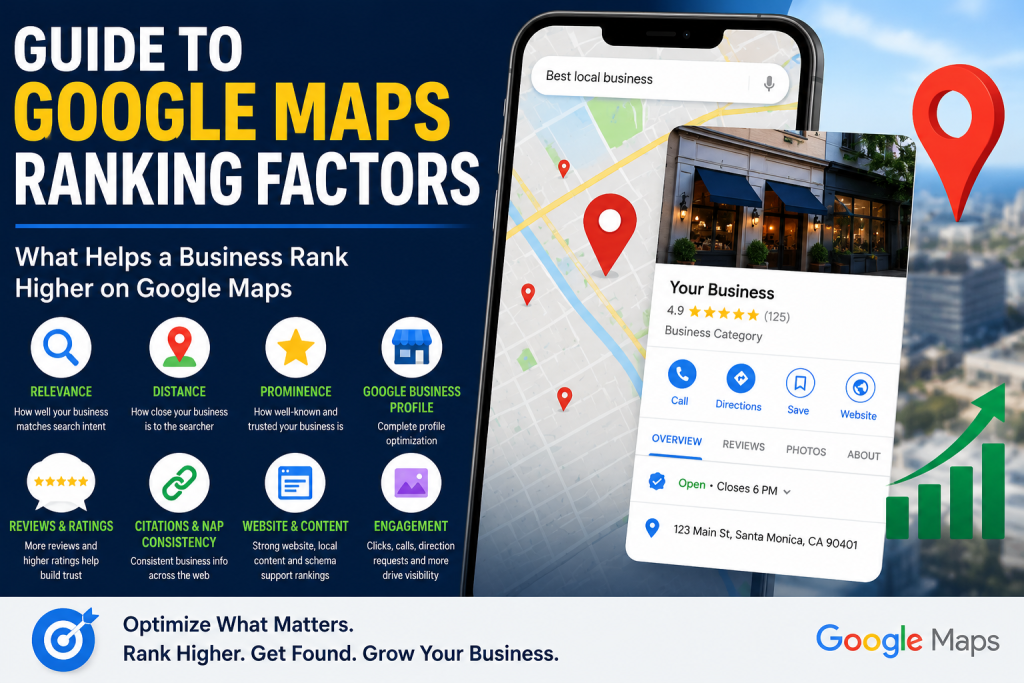
Guide to Google Maps Ranking Factors: What Helps a Business Rank Higher on Google Maps
Understanding Google Maps ranking factors is essential for any local business that wants more phone calls, website visits, direction requests, appointments, and qualified leads from nearby customers. Google Maps visibility is not based on one single factor. It is built through a combination of business relevance, location signals, customer trust, profile optimization, reviews, website strength, citations, and local authority.
Google explains that local results are based primarily on three factors: relevance, distance, and prominence. These factors help Google return the best local results for a searcher’s query. Google also states that complete and accurate business information can help businesses show up in relevant local searches. You can read Google’s official local ranking guidance here: Tips to improve your local ranking on Google.
For business owners, this means Google Maps SEO is not about one trick. It is about building a strong local search foundation that helps Google understand what your business does, where it operates, how trusted it is, and why it should be shown to customers searching nearby.
This guide explains the major Google Maps ranking factors and how they work together to improve local visibility.
What Are Google Maps Ranking Factors?
Google Maps ranking factors are the signals Google uses to decide which businesses appear in Google Maps and local pack results for a specific search.
When someone searches for a local business, Google has to decide which listings are most relevant, nearby, and trustworthy. For example, a person searching for “dentist near me,” “roof repair Santa Monica,” “personal injury attorney near me,” or “SEO company near me” is usually looking for a real business that can help quickly.
Google compares different local businesses based on many signals. These signals can include the business category, business location, searcher location, Google Business Profile information, reviews, website content, citations, links, photos, services, search intent, and overall online prominence.
The goal is to show the searcher the most useful local results.
The Three Core Google Local Ranking Factors
Google’s official documentation explains that local ranking is based mainly on relevance, distance, and prominence. These three concepts are the foundation of Google Maps SEO.
Relevance
Relevance is how well a business profile matches what someone is searching for.
If a customer searches for “emergency plumber,” Google wants to show plumbers that are relevant to emergency plumbing services. If a customer searches for “Google Maps SEO company,” Google wants to show businesses that are relevant to local SEO, Google Maps optimization, and SEO services.
Relevance is influenced by your Google Business Profile category, services, business description, website content, reviews, products, photos, posts, and overall business entity signals.
This is why complete and accurate business information matters. The more clearly your business explains what it does, the easier it is for Google to match your profile with relevant searches.
Distance
Distance refers to how far a business is from the location used in the search.
If a searcher includes a city, neighborhood, or specific area in the query, Google may use that location to calculate distance. If the searcher does not include a location, Google may use what it knows about the searcher’s current location.
This is why proximity matters so much in Google Maps rankings.
A business may rank very well near its physical address but become less visible as the searcher moves farther away. This is also why Google Maps rankings can change depending on where the search is performed.
You cannot fully control proximity, but you can strengthen relevance and prominence so your business has a better chance of ranking across a wider local area.
Prominence
Prominence refers to how well-known and trusted a business appears online and offline.
Google’s local ranking documentation explains that prominence is based on information Google has about a business from across the web, including links, articles, directories, review count, review score, and your position in web results. Google also states that more reviews and positive ratings can improve local ranking. Google’s local ranking documentation explains this directly.
Prominence can be supported by reviews, citations, backlinks, local mentions, brand searches, website authority, public reputation, and strong business information across trusted platforms.
Google Business Profile Optimization
Your Google Business Profile is one of the most important assets for Google Maps SEO.
A complete profile helps customers and search engines understand your business. Google recommends keeping business information complete and accurate, including the business address, phone number, category, attributes, hours, photos, and other key details.
A strong Google Business Profile should include:
- Accurate business name
- Correct address or service area
- Primary phone number
- Website URL
- Primary category
- Relevant secondary categories
- Business hours
- Holiday hours
- Services
- Products when relevant
- Photos
- Business description
- Attributes
- Review responses
- Google Posts
- Questions and answers
Google Maps SEO starts with the profile because that is the listing customers see in local results. If the profile is incomplete, outdated, or inaccurate, it can weaken both rankings and conversions.
For a deeper service-level breakdown, your profile optimization should connect to a larger Google Maps SEO company strategy that includes categories, reviews, citations, local content, schema, and ongoing rank tracking.
Business Categories
Business categories are one of the clearest relevance signals inside a Google Business Profile.
Your primary category tells Google what your business mainly is. Your secondary categories help explain other major services or departments. Choosing the wrong category can weaken relevance, while choosing the right category can help Google match your business to the correct searches.
Google’s Business Profile documentation explains that businesses should select categories that best describe the business and avoid using categories for every product or service. You can review Google’s category guidance here: Google Business Profile category guidance.
For example, a law firm should use the most accurate legal category. A roofing company should use a roofing-related category. A dentist should use a dental category. A marketing agency should use the closest accurate category available and support it with services, website content, citations, and reviews.
Choosing categories is not just setup work. It is part of local SEO strategy. I explain this more in the article on choosing business categories on Google.
Reviews and Ratings
Reviews are one of the strongest trust signals for Google Maps visibility and customer conversion.
Google states that review count and review score factor into local search ranking, and that more reviews and positive ratings can improve a business’s local ranking. Reviews also help customers decide whether to call, visit, book, or trust the business.
Reviews can influence Google Maps SEO in several ways:
- They support prominence.
- They increase trust with potential customers.
- They can mention important services naturally.
- They improve conversion from the map listing.
- They create fresh customer-generated content.
- They help differentiate your business from competitors.
A strong review strategy should focus on getting real reviews from real customers, responding professionally, addressing negative feedback, and building long-term trust.
Fake reviews, review gating, or manipulative review tactics can create risk. The best approach is to build a consistent review request process that follows platform rules and reflects real customer experiences.
Review Responses
Responding to reviews is not just a reputation management task. It is part of customer trust and profile activity.
When a business responds to reviews, it shows customers that the business is active and attentive. Positive review responses can reinforce services, appreciation, and professionalism. Negative review responses can show accountability and customer care.
A good review response should be specific enough to feel human, but not so detailed that it reveals private customer information.
For example, instead of writing the same generic response every time, businesses should respond naturally while keeping the tone professional.
Review responses also help future customers evaluate how the business communicates.
Business Information Accuracy
Accurate business information is a major local SEO foundation.
Google recommends keeping business information up to date so customers know what the business does, where it is, and when they can visit. Inaccurate information can hurt both visibility and customer experience.
Important business information includes:
- Business name
- Address
- Phone number
- Website
- Hours
- Holiday hours
- Business category
- Services
- Attributes
- Service areas
If a customer finds outdated hours, a wrong address, or an old phone number, that can lead to lost business. If Google sees inconsistent information across multiple sources, it may reduce confidence in the business entity.
Local Citations and NAP Consistency
Local citations are online mentions of your business information, usually including your name, address, phone number, and website.
NAP consistency means your business name, address, and phone number are accurate and consistent across the web.
Citations can appear on directories, maps platforms, local websites, review sites, chamber of commerce pages, industry directories, and business profiles.
Citations help support prominence and entity clarity. When your business information is consistent across trusted platforms, Google can have more confidence that your business is real, active, and connected to a specific location or service area.
Inconsistent citations can create confusion. For example, if your Google Business Profile has one phone number, Yelp has an old phone number, Apple Maps has an old address, and your website uses a different business name, that creates mixed signals.
Citation cleanup should be one of the first steps in any Google Maps ranking campaign.
Website Strength and Organic Rankings
Your website can influence Google Maps performance.
Google’s documentation states that your position in web results is also a factor in local ranking, which means standard SEO practices also apply to local search. This is why a strong website can support better Google Maps visibility.
Your website should clearly explain:
- Who your business is
- What services you provide
- Where you provide those services
- Why customers should trust you
- How customers can contact you
Strong service pages, location pages, internal links, schema markup, FAQs, case studies, and helpful articles all support the business entity.
If your website ranks organically for local service keywords, that can support your overall prominence and strengthen your local SEO system.
Service Pages and Location Pages
Service pages and location pages help Google understand what your business offers and where you offer it.
A service page should focus on one main service. A location page should focus on one city, area, or branch location. These pages should be helpful, specific, and written for real customers.
For example, a Google Maps SEO company may have service pages explaining Google Business Profile optimization, citation building, review strategy, local SEO audits, rank tracking, and schema markup.
A contractor may have service pages for roof repair, roof replacement, emergency roofing, gutter installation, and storm damage repair.
A dentist may have pages for dental implants, teeth cleaning, emergency dentistry, cosmetic dentistry, and Invisalign.
These pages help connect search intent to specific business offerings. They also give Google and AI systems more crawlable context about the business.
Structured Data and Local Business Schema
Structured data helps search engines understand information on a page more clearly.
Google explains that Local Business structured data can tell Google about business hours, departments, reviews, and other business details. You can review Google’s official Local Business structured data documentation here: Local Business structured data.
Schema markup does not replace Google Business Profile optimization, but it supports entity clarity by organizing business details in a structured format.
Useful schema types for local SEO can include:
- LocalBusiness schema
- Organization schema
- Service schema
- FAQPage schema
- BreadcrumbList schema
- Article schema
- Review schema when eligible and compliant
Google also explains that structured data can help Google understand page content. You can reference Google’s structured data introduction here: Introduction to structured data markup in Google Search.
For AI search, structured data can support clarity because it helps define the business, services, locations, and page relationships.
Photos and Visual Activity
Photos can improve customer engagement on a Google Business Profile.
Photos help customers see the business, team, products, services, environment, completed work, or storefront. They can also help build confidence before a customer calls or visits.
Businesses should upload high-quality, real photos instead of relying only on stock images. Useful photos can include:
- Exterior photos
- Interior photos
- Team photos
- Product photos
- Service photos
- Before-and-after photos when appropriate
- Jobsite photos
- Branded images
Photo activity does not replace core ranking factors, but it helps keep the profile fresh and improves customer trust.
Google Posts
Google Posts allow businesses to share updates, offers, events, announcements, and service-related content directly on the Google Business Profile.
Posts can help keep the profile active and provide customers with useful information. They can also reinforce services, promotions, seasonal updates, and local relevance.
A good Google Posts strategy may include:
- Service highlights
- Special offers
- Company updates
- Local event mentions
- FAQs
- Seasonal reminders
- Case study summaries
Google Posts should not be spammed with keywords. They should be useful, clear, and connected to what customers care about.
Products and Services
The products and services sections of a Google Business Profile help explain what the business offers.
For service businesses, the services section is especially important because it gives Google and customers more detail about what the business provides.
Google’s documentation explains that businesses can manage services on their Business Profile and select services they offer. You can reference Google’s official documentation here: Manage services on your Business Profile.
Services should be accurate, specific, and aligned with the website.
If your profile lists a service, your website should ideally have supporting content for that service. This creates better alignment between your Business Profile and website.
Questions and Answers
The Google Business Profile Q&A section can help customers get quick answers before contacting the business.
Questions and answers can also support local relevance because they provide more information about services, policies, hours, pricing, appointment process, parking, service areas, and customer concerns.
Businesses should monitor their Q&A section because customers or users can ask and answer questions. If incorrect information appears, it can create confusion.
A good Q&A strategy includes answering common questions clearly and consistently.
User Engagement Signals
Google Maps listings are designed for customer action.
When users find a profile, they may call, click the website, request directions, read reviews, view photos, book an appointment, or save the listing.
These engagement actions show whether the profile is useful to customers. While Google does not disclose every weighting detail, engagement is important because it affects real business outcomes.
The goal is not only to rank. The goal is to convert visibility into calls, visits, leads, and customers.
A business with strong photos, clear services, good reviews, accurate hours, and a helpful website will usually convert better than a business with an incomplete or neglected profile.
Proximity and Search Location
Proximity is one of the most misunderstood Google Maps ranking factors.
Many business owners think they should rank everywhere in a city, but Google Maps results are highly location-sensitive. A business may rank in one part of a city and not rank in another part of the same city.
This happens because Google considers the distance between the searcher and the business, or the distance between the searched location and the business.
Proximity cannot be manipulated the same way content can be optimized. A business cannot be physically close to every searcher.
However, stronger relevance and prominence can help a business compete better outside its immediate location.
Local Backlinks and Brand Mentions
Backlinks and brand mentions can support local prominence.
A backlink from a relevant local website, industry association, news source, chamber of commerce, partner, sponsor page, or community organization can help strengthen local authority.
Brand mentions can also help reinforce that the business is active in a specific market or industry.
Examples of local backlink opportunities include:
- Local sponsorships
- Chamber of commerce memberships
- Industry associations
- Local news features
- Community event pages
- Partner pages
- Local resource pages
- Guest articles on relevant local sites
Backlinks should be earned from relevant and trustworthy websites. Low-quality link schemes can create risk and do not build long-term authority.
Content Relevance and Topical Authority
Content helps Google understand the depth of your business expertise.
A strong local SEO content strategy should answer real customer questions and support the services the business wants to rank for.
Examples of local SEO content include:
- Service pages
- Location pages
- Frequently asked questions
- Buying guides
- Comparison pages
- Case studies
- Local guides
- Problem-solution articles
- Industry education pages
For LLM and AI search visibility, content should be clear, specific, structured, and entity-focused. AI systems need crawlable information that explains who the business is, what it does, where it operates, and why it is trustworthy.
This is why NLP-focused content should use natural language around related entities, services, locations, questions, and customer intent.
E-E-A-T and Local Trust
E-E-A-T stands for experience, expertise, authoritativeness, and trustworthiness.
For local businesses, E-E-A-T can be supported through real business details, owner or team information, case studies, reviews, credentials, photos, testimonials, service explanations, transparent contact information, and helpful content.
Google Maps SEO is not only about ranking signals. It is also about proving that the business is legitimate and trustworthy.
Ways to strengthen local E-E-A-T include:
- Show real business contact information.
- Publish helpful service pages.
- Add team or founder information when relevant.
- Show real project examples or case studies.
- Maintain accurate citations.
- Respond professionally to reviews.
- Use original photos.
- Display certifications, licenses, or memberships when applicable.
- Keep content updated.
Trust is especially important for industries where customers are making high-value or high-risk decisions.
AI Search, AEO, GEO, and Google Maps Ranking Factors
AI search does not remove the need for local SEO. It increases the need for clear, trusted, crawlable business information.
AI systems and large language models need to understand business entities. They use available information such as websites, business profiles, citations, reviews, structured data, and third-party mentions to understand and summarize businesses.
This is where AEO and GEO connect to Google Maps SEO.
AEO, or Answer Engine Optimization, focuses on helping search systems answer questions clearly.
GEO, or Generative Engine Optimization, focuses on helping AI systems understand, summarize, and recommend a business accurately.
For local businesses, that means your Google Maps ranking factors should also support AI understanding.
Your profile, website, citations, reviews, schema, service pages, and content should all reinforce the same business identity.
How to Track Google Maps Ranking Factors
Tracking is important because Google Maps rankings can change by location, device, keyword, and search intent.
A business should track more than one keyword from one location. Google Maps results are proximity-based, so grid tracking can help show where a business ranks across different parts of a city or service area.
Important metrics to monitor include:
- Google Maps rankings
- Local pack rankings
- Organic rankings
- Google Business Profile calls
- Website clicks
- Direction requests
- Bookings
- Messages
- Form submissions
- Discovery searches
- Branded searches
- Review growth
- Citation accuracy
- Photo views
- Competitor movement
Tracking should be used to guide decisions, not just create reports. If rankings drop, review categories, profile changes, reviews, citations, competitors, website health, and local search updates.
Common Mistakes That Hurt Google Maps Rankings
Many businesses hurt their own Maps visibility by ignoring foundational issues.
Common mistakes include:
- Choosing the wrong primary category
- Using too many unrelated secondary categories
- Having inconsistent NAP information
- Ignoring duplicate listings
- Using outdated business hours
- Not responding to reviews
- Having thin service pages
- Using stock photos only
- Not adding services to the profile
- Ignoring local citations
- Not tracking rankings by location
- Keyword stuffing the business name
- Creating weak location pages
- Ignoring website SEO
- Making too many profile changes at once
Most ranking problems are not caused by one issue. They are usually caused by multiple weak signals stacking together.
How to Improve Google Maps Rankings
To improve Google Maps rankings, start with the foundation.
First, make sure your Google Business Profile is complete and accurate. Then confirm your primary category and secondary categories. Add services, update hours, upload real photos, respond to reviews, and keep the profile active.
Next, strengthen your website. Build service pages, location pages, internal links, FAQs, schema markup, and helpful content that supports your local SEO goals.
Then clean up citations and NAP consistency. Make sure your business information is accurate across major directories, local platforms, industry websites, and maps services.
After that, build trust. Generate real reviews, earn local backlinks, publish expert content, show proof of experience, and create clear conversion paths for customers.
Finally, track results. Monitor Maps visibility, calls, clicks, rankings, leads, and competitor movement.
The strongest results come from improving all major signals together.
Final Thoughts
Google Maps ranking factors are built around relevance, distance, and prominence, but those three factors are supported by many practical SEO actions.
Your business category helps Google understand what your business is. Your location affects proximity. Your reviews support trust and prominence. Your citations confirm business information. Your website builds relevance and authority. Your schema organizes business details. Your content helps Google and AI systems understand your services. Your engagement signals show how customers interact with your listing.
Google Maps SEO is not one tactic. It is a system.
Businesses that want stronger local visibility should focus on accuracy, consistency, trust, service relevance, customer engagement, and ongoing improvement.
When these signals work together, a business has a stronger chance of ranking higher on Google Maps, earning more local visibility, and turning search traffic into real customers.
FAQs
What are the main Google Maps ranking factors?
The main Google Maps ranking factors are relevance, distance, and prominence. Relevance is how well your business matches the search. Distance is how close your business is to the searcher or searched location. Prominence is how trusted and well-known your business appears online and offline.
Does Google Business Profile optimization help Maps rankings?
Yes, Google Business Profile optimization can help Maps rankings because it improves how clearly Google understands your business. Accurate categories, services, hours, photos, descriptions, reviews, and profile updates all support local relevance and customer engagement.
Do reviews affect Google Maps rankings?
Yes, reviews can affect Google Maps rankings. Google states that review count and review score factor into local ranking, and more reviews and positive ratings can improve local ranking. Reviews also help customers decide whether to contact or visit a business.
How important are business categories for Google Maps SEO?
Business categories are very important because they help Google understand what your business is. The primary category is especially important because it is one of the clearest relevance signals on your Google Business Profile.
Can citations help Google Maps rankings?
Yes, citations can support Google Maps rankings by confirming your business name, address, phone number, website, and location across the web. Accurate citations help strengthen business identity, trust, and local prominence.
Does my website affect Google Maps rankings?
Yes, your website can affect Google Maps rankings. Google says your position in web results is also a factor in local ranking. A strong website with service pages, location pages, internal links, schema, and helpful content can support your local SEO performance.
Why do Google Maps rankings change by location?
Google Maps rankings change by location because distance is a major ranking factor. A business may rank well near its address but appear lower farther away. Results can also change based on the searcher’s location, device, query, and competition.
Does schema markup help Google Maps SEO?
Schema markup can support Google Maps SEO by helping Google understand business information on your website. LocalBusiness schema, Organization schema, Service schema, FAQ schema, and Breadcrumb schema can all help organize business details clearly.
How long does it take to improve Google Maps rankings?
The timeline depends on competition, location, profile strength, reviews, citations, website authority, and current rankings. Some improvements may show in weeks, while competitive markets may require several months of consistent optimization.
What is the best way to improve Google Maps rankings?
The best way to improve Google Maps rankings is to optimize the full local SEO system. That includes your Google Business Profile, categories, services, reviews, citations, NAP consistency, website content, local pages, schema markup, backlinks, photos, posts, and ongoing rank tracking.