
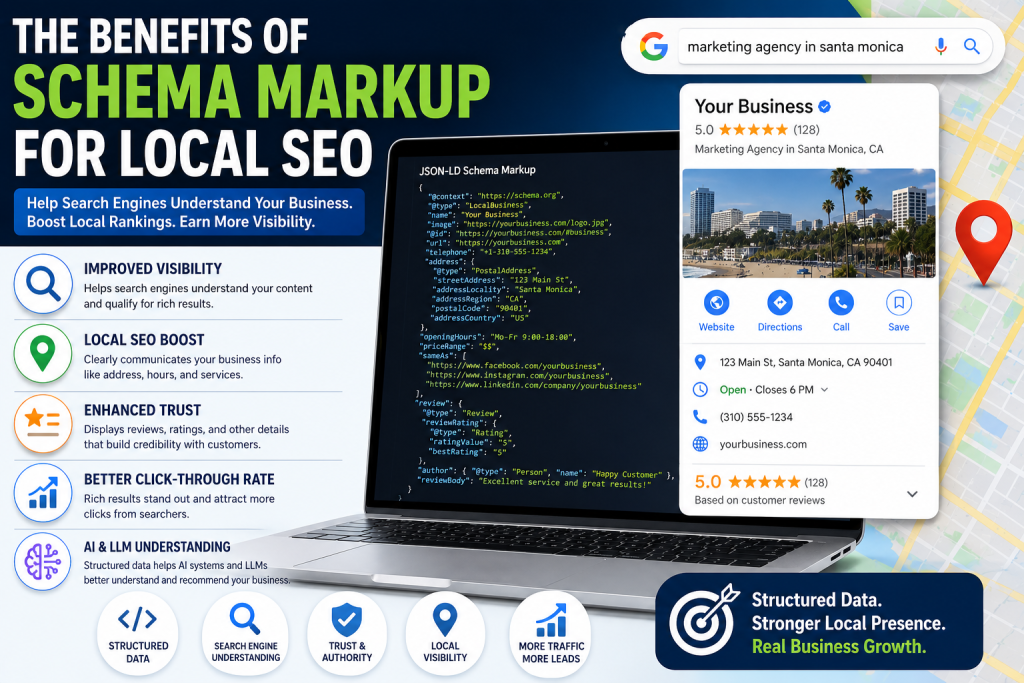
Benefits of Schema Markup for Local SEO: How Structured Data Helps Google, AI Search, and Local Businesses
The benefits of schema markup for local SEO are tied to clarity, trust, and search engine understanding. Schema markup, also called structured data, helps search engines better understand the content on a page. For local businesses, this can include business name, address, phone number, hours, services, reviews, logo, website, service area, social profiles, and other important business details.
Schema markup does not replace local SEO. It does not replace a strong Google Business Profile, accurate citations, customer reviews, service pages, backlinks, or helpful content. However, schema markup supports all of those signals by organizing business information in a structured format that search engines can process more easily.
Google explains that structured data is a standardized format for providing information about a page and classifying the page content. Google also states that it uses structured data to understand page content and gather information about the web and the world in general. You can read Google’s official documentation here: Introduction to structured data markup in Google Search.
For local SEO, schema markup helps connect your website, services, brand, locations, reviews, and business entity. This is why it should be part of a complete Google Maps SEO company strategy, especially for businesses that want stronger visibility in Google Search, Google Maps, AI search, and local discovery results.
What Is Schema Markup?
Schema markup is structured code added to a webpage to help search engines understand the meaning of the content.
Instead of only reading visible text, search engines can also read structured data that labels information more clearly. For example, schema can identify a business as a local business, an organization, a service provider, an article, a FAQ page, a review, a product, or another defined entity.
For local SEO, schema markup can help define important business information such as:
- Business name
- Business type
- Address
- Phone number
- Website URL
- Logo
- Business hours
- Service area
- Services offered
- Social profile links
- Reviews when eligible
- Founder or organization details
- Article information
- FAQ content
- Breadcrumb structure
The most common format for schema markup is JSON-LD. Google’s structured data guidelines state that JSON-LD is the recommended format for structured data. You can review Google’s general structured data guidelines here: General structured data guidelines.
Why Schema Markup Matters for Local SEO
Local SEO depends on how well search engines understand a business.
Google needs to understand who the business is, what services it provides, where it operates, how customers can contact it, and whether the business information is trustworthy. Schema markup helps organize that information clearly.
For example, a local business may have a Google Business Profile, service pages, location pages, reviews, citations, social profiles, and blog content. Schema markup helps connect those pieces by giving search engines structured information about the business entity.
This matters because local SEO is not based on one signal. It is based on many signals working together.
Your Google Business Profile tells Google how your business appears in Maps and local search.
Your website explains your services and expertise.
Your citations confirm your business information across the web.
Your reviews build trust and customer confidence.
Your schema markup helps structure the information so search engines and AI systems can interpret it more clearly.
Schema Markup Helps Google Understand Your Business Entity
One of the biggest benefits of schema markup for local SEO is entity clarity.
An entity is a clearly identifiable business, person, place, organization, product, or service. For local SEO, your business is the entity.
Schema markup can help Google understand details about your business entity, such as your official name, website, logo, phone number, address, service area, and social profiles.
Google’s Organization structured data documentation says adding organization structured data to a homepage can help Google better understand an organization’s administrative details and disambiguate the organization in search results. You can read Google’s source here: Organization structured data.
This is important because businesses often have information spread across many platforms. If your website, Google Business Profile, citations, social profiles, and schema markup all support the same identity, your business becomes easier to understand.
This also connects directly to consistent branding online, because schema should match the same business name, logo, website, phone number, and social profiles used across your digital footprint.
Schema Markup Supports Local Business Details
LocalBusiness schema is especially useful for local SEO because it can define business details in a structured way.
Google’s Local Business structured data documentation explains that local business structured data can help Google display business details in Search and Maps. Google also states that Local Business structured data can tell Google about business hours, different departments within a business, reviews when appropriate, and more. You can read the official source here: Local Business structured data.
For a local business, LocalBusiness schema can help organize important details such as:
- Business name
- Business type
- Address
- Phone number
- Opening hours
- Geo coordinates
- Website URL
- Logo
- Images
- Departments
- Service area
- Price range
- Accepted payment methods when relevant
This does not mean every local business will receive a rich result. Google clearly states that using structured data does not guarantee that features will appear in search results. But structured data still helps search engines interpret business information more clearly when it is implemented correctly.
Schema Markup Can Improve Rich Result Eligibility
Another benefit of schema markup is eligibility for certain rich results in Google Search.
Google explains that structured data can help content appear in richer ways in search results, also known as rich results. The exact result depends on the structured data type, eligibility, page quality, Google’s guidelines, and whether Google chooses to display the enhancement.
Examples of structured data types that may support richer search appearances include:
- LocalBusiness schema
- Organization schema
- Review snippet schema
- FAQPage schema where eligible
- Article schema
- BreadcrumbList schema
- Product schema when relevant
- Service-related schema using schema.org vocabulary
Google’s Search Gallery explains which structured data features Google supports in Search. You can review it here: Structured data markup that Google Search supports.
For local SEO, the main goal is not to chase visual enhancements. The main goal is to make business information clearer, more accurate, and easier for search systems to process.
Schema Markup Helps Connect Website Content to Google Business Profile Signals
Your website and Google Business Profile should support each other.
A Google Business Profile helps your business appear in Google Maps and local search. Your website provides deeper information about your services, locations, team, expertise, case studies, FAQs, and contact options.
Schema markup helps connect the website side of the local SEO strategy by clearly labeling business information on your pages.
For example, if your Google Business Profile lists your business as a marketing agency, your website should support that with service pages, location pages, internal links, and structured data. If your profile lists Google Maps SEO services, your website should clearly explain those services. If your website schema lists your organization name, logo, URL, and social profiles, those details should match your Google Business Profile and citations.
This alignment improves entity clarity.
When the profile, website, citations, schema, and reviews all reinforce the same business identity, your local SEO foundation becomes stronger.
Schema Markup Helps AI Search and LLM Understanding
Schema markup can also support AI search visibility because AI systems need clear and consistent information to understand businesses.
Large language models and AI-driven search systems rely on accessible information across the web. They need to identify what a business is, what services it offers, where it operates, and why it may be relevant to a user’s question.
Schema markup helps by creating structured relationships between your business, services, pages, reviews, organization details, and local information.
This matters for AEO and GEO.
AEO, or Answer Engine Optimization, focuses on helping search systems answer questions clearly.
GEO, or Generative Engine Optimization, focuses on helping AI systems understand, summarize, and recommend a business accurately.
Schema markup supports both because it adds machine-readable clarity to your website.
For example, if someone asks an AI system for a local SEO company, Google Maps SEO provider, or marketing agency in Santa Monica, AI systems need trusted information to understand which businesses match that intent. Schema markup can help support that understanding when combined with strong content, Google Business Profile optimization, citations, reviews, and local authority.
Schema Markup Strengthens E-E-A-T Signals
E-E-A-T stands for experience, expertise, authoritativeness, and trustworthiness.
Schema markup does not automatically prove E-E-A-T, but it can support trust by organizing important details about your business, authorship, organization, services, reviews, and content.
For example, Organization schema can identify the business. LocalBusiness schema can identify business details. Article schema can identify the author, headline, date published, and date modified. Breadcrumb schema can clarify site structure. FAQ schema can structure common customer questions when eligible.
Google’s Article structured data documentation says Article structured data can help Google understand more about the webpage and show better title text, images, and date information for articles in search results. You can review Google’s reference here: Article structured data.
When schema is accurate and matches the visible content, it supports transparency and trust.
When schema is misleading, spammy, or not visible to users, it can create problems and may violate Google’s structured data guidelines.
Schema Markup and Reviews
Reviews are important for local trust, conversions, and Google Maps visibility. Schema markup can help structure review information when it is eligible and follows Google’s guidelines.
Google’s Review snippet documentation explains that a review snippet is a short excerpt of a review or rating from a review website, and that when Google finds valid reviews or ratings markup, it may show a rich snippet with stars or summary information. You can read the official documentation here: Review snippet structured data.
However, review schema must be used carefully. Not every review situation qualifies for review rich results, and Google has guidelines around how review markup should be used.
For local businesses, reviews should be real, relevant, and connected to actual customer experiences. Schema markup should not be used to fake ratings or manipulate search results.
If you want to understand the local SEO side of reviews, read this article on how reviews affect Google Maps SEO.
Schema Markup Helps Clarify Services
Service clarity is important for both local SEO and AI search.
A local business may offer multiple services, but search engines need to understand which services are real, important, and connected to the business.
Schema can help organize service information by connecting services to the organization or local business. This can support search understanding when it matches the visible service content on the page.
For example, an SEO company may have service pages for:
- Google Maps SEO
- Local SEO
- Google Business Profile optimization
- Review strategy
- Citation building
- Schema markup
- Multi-location SEO
- SEO audits
Each service page should clearly explain the service for users. Schema can then support the page by structuring the information for search engines.
The visible content comes first. The schema supports it.
Schema Markup Supports Internal Linking and Site Structure
Schema markup can also support site structure.
BreadcrumbList schema can help search engines understand the hierarchy of pages on a website. Article schema can identify blog content. Organization schema can connect the site to the brand. LocalBusiness schema can connect the site to a local business entity.
For a local SEO silo, this matters because related pages should support one another.
For example, a top-level Google Maps SEO page may be supported by articles about ranking factors, citations, reviews, categories, branding, and schema markup. Internal links help users and search engines move between those pages. Schema helps search engines interpret what those pages are about.
Together, internal linking and schema markup create a clearer topical structure.
Schema Markup and Consistent Branding
Schema markup should match your branding across the web.
If your visible brand name is one thing, your Google Business Profile says another, and your schema uses a third version, that creates inconsistency.
Your schema should reinforce the same official business identity used on your website, Google Business Profile, citations, and social profiles.
Important branding details in schema may include:
- Official business name
- Website URL
- Logo URL
- Phone number
- Address
- Social profile links
- Founder or organization information
- Business category
- Service area
This is why schema markup should not be handled separately from branding. It should be part of the same entity-building process.
Schema Markup Can Reduce Ambiguity
Many businesses have similar names, similar services, or similar locations.
Schema markup helps reduce ambiguity by clearly defining business details.
For example, a business may have a name that is similar to another company in another city. Organization schema and LocalBusiness schema can help clarify which business the website represents by including the correct URL, logo, phone number, address, sameAs links, and business details.
This matters for branded search, local search, AI search, and entity recognition.
The clearer your business entity is, the easier it becomes for search systems to associate your website with the correct business.
Schema Markup Helps With Content Understanding
Schema markup can help search engines understand different content types on your site.
For example:
- Article schema can identify blog articles.
- FAQPage schema can structure eligible question-and-answer content.
- BreadcrumbList schema can clarify page hierarchy.
- Organization schema can identify the company.
- LocalBusiness schema can identify local business details.
- Review schema can structure eligible review content.
- Product schema can support eligible product information.
Google’s FAQ structured data documentation explains that FAQ structured data can help users discover information in a rich result when eligible, but Google also notes that it does not guarantee rich result display. You can review the documentation here: FAQ structured data.
For local SEO, this is useful because a website may include many types of content: service pages, blog articles, FAQs, reviews, location pages, and contact pages. Schema markup helps classify those pages more clearly.
Schema Markup Does Not Replace Good Content
One common mistake is thinking schema markup can make weak content rank.
It cannot.
Schema markup supports good content. It does not replace it.
If a local business has thin service pages, weak reviews, inaccurate citations, an incomplete Google Business Profile, and poor website content, schema markup alone will not solve the problem.
Google’s structured data guidelines state that structured data should represent the main content of the page and should not be misleading. This means your schema should match what users can see and verify on the page.
The best approach is to create helpful content first, then add accurate structured data to support that content.
Common Schema Markup Mistakes
Schema markup can help local SEO, but incorrect implementation can create problems.
Common schema mistakes include:
- Using the wrong schema type
- Adding schema that does not match visible page content
- Using fake review markup
- Marking up content that users cannot see
- Using outdated business information
- Using a logo URL that does not work
- Using inconsistent business names
- Forgetting sameAs links
- Adding duplicate or conflicting schema
- Not validating schema with Google tools
- Ignoring required or recommended properties
The goal is not to add as much schema as possible. The goal is to add accurate schema that helps clarify the page.
How to Test Schema Markup
Schema should be tested before and after publishing.
Google provides the Rich Results Test to check which Google rich results can be generated by structured data on a page. Google also notes that the test can preview how rich results may look in Search. You can access Google’s testing tool here: Google Rich Results Test.
Google also recommends using the URL Inspection tool in Search Console to identify issues after pages are indexed.
Testing is important because a small syntax error can break schema markup. It is also important because schema may be technically valid but still not eligible for a specific Google rich result if it does not follow Google’s feature guidelines.
Which Schema Types Matter Most for Local SEO?
The best schema types depend on the page and business.
For most local businesses, the most useful schema types include:
- Organization schema for the main business entity
- LocalBusiness schema for local business details
- Service schema for service pages
- Article schema for blog posts
- FAQPage schema for eligible FAQ content
- BreadcrumbList schema for navigation structure
- Review schema when eligible and compliant
- Product schema when the business has eligible products
Not every page needs every schema type.
A homepage may need Organization or LocalBusiness schema. A service page may need Service schema and BreadcrumbList schema. A blog post may need Article schema. A FAQ section may use FAQPage schema when eligible. A review page may use review-related markup only when it follows Google’s guidelines.
Schema should match page purpose.
Schema Markup and Google Maps Rankings
Schema markup is not a direct replacement for Google Maps optimization.
However, it can support Google Maps SEO by strengthening business understanding and connecting website information to local business details.
Google Maps rankings are influenced by many signals, including relevance, distance, and prominence. Schema markup can support relevance and entity clarity by helping Google understand business details on the website.
For example, LocalBusiness schema can help clarify the business address, phone number, opening hours, and website. Organization schema can clarify the brand. Service schema can clarify offerings. Review schema can structure eligible ratings. Breadcrumb schema can show page hierarchy.
These signals support a cleaner local SEO foundation.
Schema Markup and Conversion
Schema markup is mostly discussed as an SEO tool, but it can also support conversion indirectly.
When structured data helps Google display clearer information in search results, customers may better understand the business before they click. When the website has consistent structured business information, the customer journey becomes more trustworthy.
For local businesses, conversion depends on trust.
If customers see accurate business information, clear services, reviews, contact options, and consistent branding, they are more likely to call, book, visit, or submit a form.
Schema supports that trust by helping the website communicate more clearly to search engines.
How Schema Markup Supports a Local SEO Silo
A local SEO silo is a group of related pages that support a main topic.
For example, a main Google Maps SEO page can be supported by articles about citations, reviews, categories, ranking factors, branding, and schema markup.
Each supporting article explains one part of the larger strategy. Internal links connect the pages. Schema markup helps clarify each page type and business entity.
This gives search engines and AI systems a stronger topical map of your site.
For example:
- The main service page explains the primary offer.
- The citations article explains business data consistency.
- The reviews article explains trust and reputation.
- The category article explains relevance.
- The ranking factors article explains the full local ranking system.
- The branding article explains entity consistency.
- The schema article explains structured business understanding.
Together, these pages support stronger topical authority around Google Maps SEO.
Best Practices for Local SEO Schema Markup
Use these best practices when adding schema markup to a local business website:
- Use JSON-LD when possible.
- Match schema to visible page content.
- Use the most accurate schema type for the page.
- Keep business name, phone number, URL, and address consistent.
- Add sameAs links for official social profiles when relevant.
- Use LocalBusiness schema for local business details.
- Use Organization schema for brand identity.
- Use Service schema for service pages.
- Use Article schema for blog posts.
- Use FAQPage schema only when appropriate and visible on the page.
- Use review markup only when eligible and compliant.
- Validate schema with Google’s Rich Results Test.
- Monitor Search Console for structured data warnings or errors.
- Update schema after business changes.
Final Thoughts
The benefits of schema markup for local SEO come from clarity, structure, and entity understanding.
Schema markup helps search engines understand your business, services, website content, reviews, organization details, and local business information more clearly. It can support rich result eligibility, strengthen entity SEO, improve AI search understanding, and reinforce consistent branding across the web.
Schema markup does not replace the fundamentals. You still need a complete Google Business Profile, accurate citations, real reviews, strong service pages, helpful content, local links, and consistent branding.
But when schema markup is implemented correctly, it helps all of those signals become easier for search engines and AI systems to understand.
For local businesses competing in Google Maps and local search, structured data should be part of the foundation, not an afterthought.
FAQs
What is schema markup for local SEO?
Schema markup for local SEO is structured data added to a website to help search engines understand local business information. It can identify details such as business name, address, phone number, hours, services, website, logo, social profiles, reviews when eligible, and business type.
Does schema markup help Google Maps rankings?
Schema markup can support Google Maps SEO by improving business understanding and entity clarity, but it does not replace Google Business Profile optimization, reviews, citations, service pages, or local authority. It works best as part of a complete local SEO strategy.
What schema types are best for local businesses?
The most useful schema types for local businesses often include LocalBusiness, Organization, Service, Article, FAQPage, BreadcrumbList, and Review schema when eligible. The right schema depends on the page type and the visible content on the page.
Can schema markup help AI search visibility?
Yes, schema markup can help AI search visibility by making business information more structured and easier to interpret. AI systems need clear information about who a business is, what it offers, where it operates, and why it is relevant. Schema helps support that understanding.
Does schema markup guarantee rich results?
No, schema markup does not guarantee rich results. Google states that structured data can make pages eligible for rich results, but Google does not guarantee that rich results will appear. The markup must also follow Google’s guidelines and match the visible page content.
Should schema markup match my Google Business Profile?
Yes, schema markup should match your Google Business Profile and website branding. Your business name, phone number, website URL, address, logo, services, and social profiles should be consistent across your website, Google Business Profile, citations, and structured data.
What is LocalBusiness schema?
LocalBusiness schema is structured data that describes a local business. It can include business type, name, address, phone number, hours, departments, reviews when eligible, and other business details. It helps search engines better understand local business information.
What is Organization schema?
Organization schema is structured data that identifies an organization or brand. It can include the official business name, logo, website, contact details, and social profile links. Google states that Organization structured data can help disambiguate the organization in search results.
How do I test schema markup?
You can test schema markup with Google’s Rich Results Test. This tool checks which Google rich results can be generated by the structured data on your page. You should also monitor Google Search Console for structured data warnings and errors.
Can bad schema hurt SEO?
Bad schema can create problems if it is misleading, inaccurate, spammy, or does not match visible page content. Google’s structured data guidelines should be followed carefully. Schema should clarify the page, not manipulate search results.