
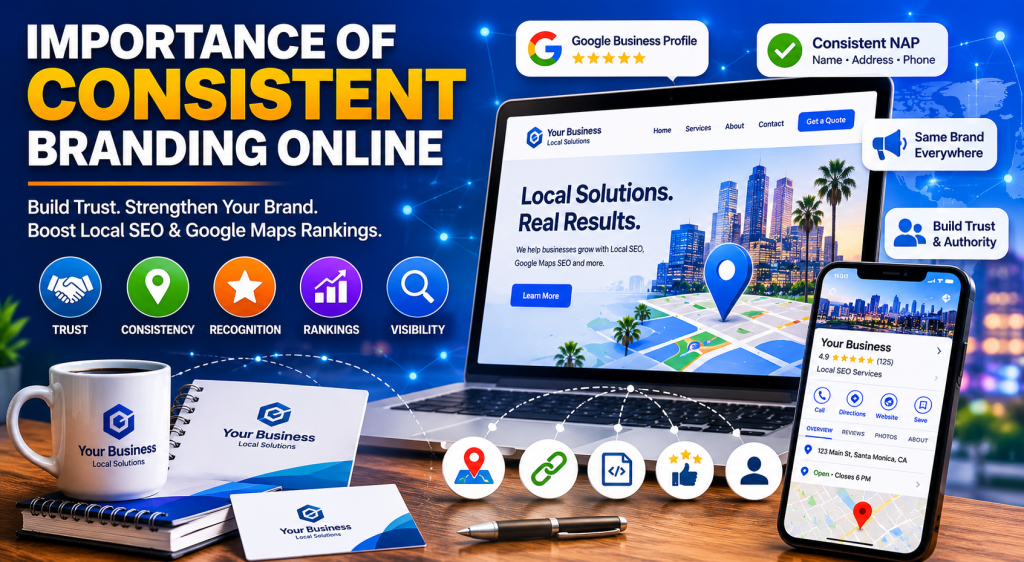
Importance of Consistent Branding Online for Local SEO, Google Maps Rankings, and AI Search Visibility
The importance of consistent branding online goes beyond having the same logo, colors, and business name across the internet. For local SEO, Google Maps rankings, and AI search visibility, consistent branding helps search engines, customers, and large language models understand who your business is, what it offers, where it operates, and whether the information about your business can be trusted.
When your business name, website, logo, phone number, address, service descriptions, social profiles, Google Business Profile, citations, schema markup, and content all send the same message, your online presence becomes easier to understand. When those signals are inconsistent, search engines and customers can receive mixed information.
For businesses trying to improve local visibility, consistent branding supports trust, entity clarity, relevance, prominence, and conversion. It also supports a stronger Google Maps SEO company strategy because Google Maps rankings depend on how clearly your business information is understood across the web.
What Is Consistent Branding Online?
Consistent branding online means your business presents the same identity across every digital platform where customers and search engines may find you.
This includes your:
- Business name
- Logo
- Website URL
- Phone number
- Address or service area
- Business categories
- Business description
- Service descriptions
- Social media profiles
- Google Business Profile
- Local citations
- Directory listings
- Schema markup
- Review platform profiles
- Email signatures
- Content tone and messaging
- Photos and visual identity
Brand consistency does not mean every platform must use the exact same paragraph. It means the facts, identity, and positioning of the business should match.
If your website says one business name, your Google Business Profile says another, your citations use an old phone number, and your social profiles use outdated branding, your business entity becomes less clear.
The goal is simple: make it easy for Google, customers, and AI systems to recognize your business as the same trusted entity everywhere it appears.
Why Consistent Branding Matters for Local SEO
Local SEO depends on trust and clarity.
Google needs to understand what your business does, where it operates, and how it should be matched to local searches. Google’s local ranking documentation explains that local results are based primarily on relevance, distance, and prominence. Google also recommends keeping business information complete and accurate so customers know what the business does, where it is, and when they can visit. You can read Google’s official guidance here: Tips to improve your local ranking on Google.
Consistent branding supports these local ranking concepts by reducing confusion.
Relevance improves when your business name, categories, services, website content, and descriptions clearly support what you want to rank for.
Prominence improves when your brand is consistently mentioned across trusted websites, directories, reviews, citations, articles, and local platforms.
Distance is based on location, but consistent branding still helps Google understand which business location or service area should be connected to the search.
When branding is inconsistent, your local SEO foundation becomes weaker. Customers may question whether they found the right business. Search engines may need to reconcile conflicting information. AI systems may summarize your business incorrectly.
Consistent Branding and Google Maps Ranking Factors
Google Maps rankings are not based only on keywords. They are influenced by a combination of relevance, distance, prominence, profile quality, reviews, citations, website content, categories, and customer engagement.
Brand consistency supports several of these signals.
Your Google Business Profile should match your website. Your website should match your citations. Your citations should match your social profiles. Your reviews should reflect the services you actually provide. Your schema markup should support the same business identity.
When those pieces align, Google receives a clearer picture of your business.
This is why branding should be part of a larger ranking strategy. If you want to understand how these pieces work together, read the full guide to Google Maps ranking factors.
Brand Consistency Helps Build Entity Clarity
Search engines do not only look at individual keywords. They also try to understand entities.
An entity is a clearly identifiable person, business, organization, place, product, service, or brand.
For local SEO, your business is the entity.
Consistent branding helps Google connect facts about your business entity, including your name, website, location, services, phone number, logo, social profiles, founder information, reviews, and local relevance.
If these facts are consistent across the web, your entity becomes easier to understand.
If these facts conflict, the entity becomes less clear.
For example, if a business uses “ABC Marketing” on its website, “ABC Digital Agency” on its Google Business Profile, “ABC SEO Services” on citations, and “ABC Media Group” on social profiles, Google may still connect the signals, but the branding is not as clean as it could be.
A clearer business entity is better for local SEO, organic SEO, Google Maps visibility, and AI search understanding.
Why Business Name Consistency Matters
Your business name is one of the strongest identity signals online.
The business name on your website, Google Business Profile, legal documents, citations, social profiles, review platforms, schema markup, and directory listings should be consistent.
This does not mean you cannot use natural brand variations in writing. But your official business name should be clear and repeated consistently across important platforms.
Business name inconsistency can create several problems:
- Customers may not know if they found the right company.
- Search engines may receive mixed entity signals.
- Directories may create duplicate listings.
- Reviews may appear across different profile versions.
- AI systems may summarize the brand incorrectly.
- Local trust can weaken.
Your business name should also avoid unnecessary keyword stuffing. The brand should be accurate, recognizable, and aligned with real-world usage.
Consistent Branding and Google Business Profile Optimization
Your Google Business Profile is often the first place customers see your business in local search.
If your profile looks different from your website, social profiles, and citations, it can create distrust.
Your Google Business Profile should have consistent branding across:
- Business name
- Logo
- Cover photo
- Business description
- Website URL
- Phone number
- Address or service area
- Primary category
- Secondary categories
- Services
- Products
- Photos
- Posts
- Q&A responses
- Review responses
The goal is to make the customer feel like they are seeing the same business no matter where they find you.
If a customer clicks from your Google Business Profile to your website, the brand should feel consistent. The logo, business name, service messaging, phone number, and offer should all match.
Brand Consistency and Local Citations
Local citations are online mentions of your business information. They commonly include your business name, address, phone number, website, categories, and description.
Citations are important because they help confirm that your business is real and connected to a specific location or service area.
Brand consistency matters because citations can either strengthen or weaken your business identity.
Strong citation consistency means your business details are accurate across major platforms, local directories, industry directories, maps platforms, review sites, and trusted third-party sources.
Weak citation consistency means outdated names, old addresses, wrong phone numbers, duplicate listings, inconsistent URLs, or mismatched descriptions are spread across the web.
When branding and citation data are aligned, search engines and AI systems have more confidence in your business entity.
How Consistent Branding Supports Schema Markup
Schema markup helps search engines understand structured information about your business, website, services, organization, and content.
Google explains that structured data can help Google understand page content and gather information about the web and the world. You can read Google’s official explanation here: Introduction to structured data markup in Google Search.
For local businesses, structured data can support brand consistency by clearly defining your business details in machine-readable language.
Google’s Local Business structured data documentation explains that LocalBusiness schema can tell Google about business hours, departments, reviews, and other business details. You can read Google’s reference here: Local Business structured data.
Google also explains that Organization structured data can help Google better understand an organization’s administrative details and disambiguate the organization in search results. You can review that source here: Organization structured data.
This is why your schema should match your branding. Your business name, logo, URL, phone number, address, sameAs profiles, and organization details should align with your website, Google Business Profile, and citations.
For a deeper breakdown, read this article on the benefits of schema markup for local SEO.
Brand Consistency and AI Search Visibility
AI search relies on clear, trusted, crawlable information.
Large language models and AI-driven search systems need to understand who your business is and how it connects to services, locations, reviews, categories, citations, and third-party mentions.
If your brand is inconsistent across the web, AI systems may struggle to summarize your business correctly.
For example, an AI system may see one version of your business name on your website, another in a directory, a different category in citations, and a different service focus on social profiles. That creates weak entity clarity.
Consistent branding helps AI systems identify repeated facts about your business.
Those repeated facts can include:
- Your official business name
- Your website
- Your business category
- Your service area
- Your phone number
- Your founder or team
- Your services
- Your reviews
- Your local market
- Your social profiles
- Your expertise
This matters for AEO and GEO.
AEO, or Answer Engine Optimization, helps search systems answer questions about your business more clearly.
GEO, or Generative Engine Optimization, helps AI systems understand, summarize, and recommend your business more accurately.
Consistent branding is not the only AI search factor, but it is part of the foundation.
Brand Consistency and E-E-A-T
E-E-A-T stands for experience, expertise, authoritativeness, and trustworthiness.
For local businesses, consistent branding supports trust because it shows that the business has a stable, recognizable identity.
Google’s helpful content documentation explains that Google’s ranking systems are designed to prioritize helpful, reliable information created to benefit people. You can read Google’s guidance here: Creating helpful, reliable, people-first content.
Brand consistency helps support reliability by making your business information easier to verify.
Local E-E-A-T can be strengthened through:
- Clear business name
- Accurate contact information
- Consistent service descriptions
- Real customer reviews
- Owner or team information
- Case studies
- Original photos
- Relevant credentials
- Consistent citations
- Clear schema markup
- Helpful educational content
When users see the same business identity across multiple trusted sources, it becomes easier to trust the company.
Website Branding and SEO
Your website is the main source of truth for your brand.
Your site should clearly show who you are, what you do, where you operate, and how customers can contact you.
Consistent website branding includes your logo, business name, navigation, page titles, service pages, contact page, footer, schema markup, internal links, images, and calls to action.
Google’s SEO Starter Guide explains that SEO is about improving a site’s presence in Search and making it easier for search engines to crawl, index, and understand content. You can review the guide here: Google SEO Starter Guide.
For local SEO, your website should not contradict your Google Business Profile or citations.
If your Google Business Profile says you offer Google Maps SEO, your website should have content that supports Google Maps SEO. If your citations say you are a marketing agency, your website should clearly explain your marketing services. If your schema says one business name, your visible branding should match.
Visual Branding and Local Trust
Visual branding includes your logo, colors, photos, icons, graphics, videos, and design style.
For local businesses, visual consistency helps users recognize your brand faster.
Your Google Business Profile, website, social profiles, email marketing, business cards, directory listings, and ads should feel connected.
This is especially important when a customer moves from one platform to another.
For example, a customer may discover your business on Google Maps, click to your website, check reviews, visit your LinkedIn profile, and then call. If every touchpoint looks disconnected, trust can drop.
If every touchpoint feels consistent, the brand feels more established.
Consistent Messaging Across Services
Branding is not only visual. It also includes messaging.
Your business should describe its services consistently across pages and platforms.
If your website says you specialize in Google Maps SEO, your Google Business Profile services should support that. If your directory listings say you provide local SEO, your content should explain local SEO. If your schema lists services, those services should match your visible service pages.
Consistent service messaging helps Google and AI systems understand your topical focus.
For example, a business that wants to rank for local SEO and Google Maps SEO should have consistent wording around:
- Google Maps SEO
- Google Business Profile optimization
- Local SEO
- Map rankings
- Local citations
- Review strategy
- Schema markup
- Service area SEO
- Multi-location SEO
This does not mean keyword stuffing. It means creating a clear topical footprint.
Social Profiles and Brand Verification
Social media profiles can help reinforce your brand identity.
Your business name, logo, website URL, contact information, service descriptions, and profile links should be consistent across platforms such as LinkedIn, Facebook, Instagram, YouTube, X, and other relevant channels.
Social profiles are especially useful for entity reinforcement because they connect your brand to real platforms and audiences.
They can also be included in Organization schema through sameAs links when appropriate.
The more consistent your social profiles are, the easier it becomes for users, search engines, and AI systems to connect them to the same brand.
Brand Consistency and Site Name in Google Search
Google provides guidance on site names in Search and recommends choosing a unique name that accurately reflects the identity of the site and is not misleading for users. Google also recommends using a concise, commonly recognized name. You can read the official source here: Site names in Google Search.
This connects directly to branding.
Your site name should match your brand identity. Your homepage branding, title tags, Organization schema, logo, and external references should all support the same business name.
If your brand name is inconsistent across your website and external sources, Google may have less clarity about how to display or understand your site name.
How Inconsistent Branding Can Hurt Local SEO
Inconsistent branding can hurt local SEO by creating confusion.
Common branding issues include:
- Different business names across platforms
- Old logos on directory listings
- Wrong website URLs
- Old phone numbers
- Outdated addresses
- Different service descriptions
- Wrong business categories
- Duplicate listings
- Inconsistent schema markup
- Different social profile names
- Mixed brand messaging
- Outdated photos
These problems may not destroy rankings by themselves, but they weaken the overall local SEO foundation.
Local SEO is cumulative. Strong signals work together. Weak signals also stack together.
If a business has inconsistent branding, thin content, weak citations, poor reviews, and incomplete profile information, it becomes harder to compete in Google Maps.
How to Audit Your Online Branding
A branding audit should review every major place your business appears online.
Start with your website.
Check your homepage, about page, contact page, service pages, footer, schema markup, title tags, meta descriptions, images, and internal links.
Then review your Google Business Profile.
Make sure your business name, logo, photos, phone number, website, categories, services, description, hours, and service area are accurate.
Then review citations.
Check major directories, industry directories, local business listings, chamber of commerce pages, maps platforms, and review websites.
Then review social profiles.
Make sure profile names, bios, logos, links, and contact details match.
Then review structured data.
Make sure Organization schema, LocalBusiness schema, Service schema, sameAs links, logo, URL, and contact information are accurate.
Brand Consistency Checklist
Use this checklist to strengthen consistent branding online:
- Use one official business name across major platforms.
- Keep your phone number consistent.
- Use the correct website URL.
- Keep your address or service area accurate.
- Use the same logo across important platforms.
- Match your Google Business Profile with your website.
- Align your citations with your business profile.
- Keep social profiles updated.
- Use consistent service descriptions.
- Make sure schema markup matches visible page content.
- Update old directories after a rebrand.
- Remove or merge duplicate listings when possible.
- Use original branded photos.
- Keep brand messaging clear and specific.
- Review your brand footprint at least twice per year.
How Consistent Branding Helps Conversions
Consistent branding does not only help SEO. It also helps customers make decisions.
When customers see the same business identity across Google Maps, your website, reviews, social profiles, and citations, trust increases.
That trust can lead to more calls, form submissions, appointment requests, direction requests, and purchases.
A customer may not consciously think about brand consistency, but they notice when something feels off.
If the phone number is different, the logo is old, the website looks unrelated, or the business name changes from platform to platform, confidence drops.
Local SEO brings visibility. Branding helps convert that visibility into customers.
How Often Should You Review Brand Consistency?
Brand consistency should be reviewed at least twice per year.
You should also review your branding anytime your business:
- Changes its business name
- Moves locations
- Changes phone numbers
- Changes website domains
- Updates its logo
- Adds a major service
- Removes a major service
- Opens a new location
- Closes a location
- Rebrands
- Changes its target market
The longer outdated branding remains online, the more cleanup may be required later.
Final Thoughts
The importance of consistent branding online is directly tied to trust, local SEO, Google Maps visibility, entity clarity, and AI search understanding.
A business with consistent branding is easier for customers to recognize, easier for Google to understand, and easier for AI systems to summarize accurately.
Your business name, website, Google Business Profile, citations, schema markup, social profiles, reviews, and content should all support the same identity.
Consistent branding helps reduce confusion and strengthen the local search foundation.
For local businesses, this is not just design work. It is SEO work. It is trust work. It is entity-building work.
When your brand is consistent across the web, your business becomes easier to find, easier to verify, and easier to choose.
FAQs
Why is consistent branding important for local SEO?
Consistent branding is important for local SEO because it helps Google and customers recognize your business as the same entity across the web. When your business name, phone number, website, address, categories, citations, schema, and service descriptions are aligned, your local SEO foundation becomes stronger.
Does consistent branding help Google Maps rankings?
Consistent branding can support Google Maps rankings by strengthening relevance, prominence, and trust. Google Maps rankings are influenced by many signals, including business information, reviews, citations, website content, and local authority. Consistent branding helps those signals work together more clearly.
What branding details should be consistent online?
Your business name, logo, phone number, address, website URL, business description, service descriptions, social profiles, Google Business Profile, citations, schema markup, and visual identity should be consistent across important platforms.
Can inconsistent branding hurt SEO?
Yes, inconsistent branding can hurt SEO by creating confusion. If your business appears with different names, phone numbers, URLs, categories, or addresses across the internet, search engines and customers may have less confidence in your business information.
How does branding affect AI search visibility?
Branding affects AI search visibility because AI systems need clear and repeated information to understand a business entity. Consistent branding across your website, Google Business Profile, citations, schema, reviews, and social profiles helps AI systems understand and reference your business more accurately.
How does schema markup support brand consistency?
Schema markup supports brand consistency by giving search engines structured information about your organization, local business, services, website, logo, contact details, and social profiles. This helps reinforce the same business identity in a machine-readable format.
Should my Google Business Profile match my website branding?
Yes, your Google Business Profile should match your website branding. The business name, logo, phone number, website URL, services, categories, photos, and description should align with the information customers see on your website.
How often should I audit my online branding?
You should audit your online branding at least twice per year. You should also review it anytime your business changes its name, location, phone number, website, logo, services, or service area.
What is the connection between branding and E-E-A-T?
Consistent branding supports E-E-A-T by improving trust and reliability. When customers see the same business identity across trusted sources, it becomes easier to verify the business and understand its experience, expertise, authority, and trustworthiness.
Is branding only about logos and colors?
No, branding is not only about logos and colors. Online branding also includes your business name, messaging, services, citations, profile information, website content, schema markup, reviews, social profiles, and overall customer experience.