
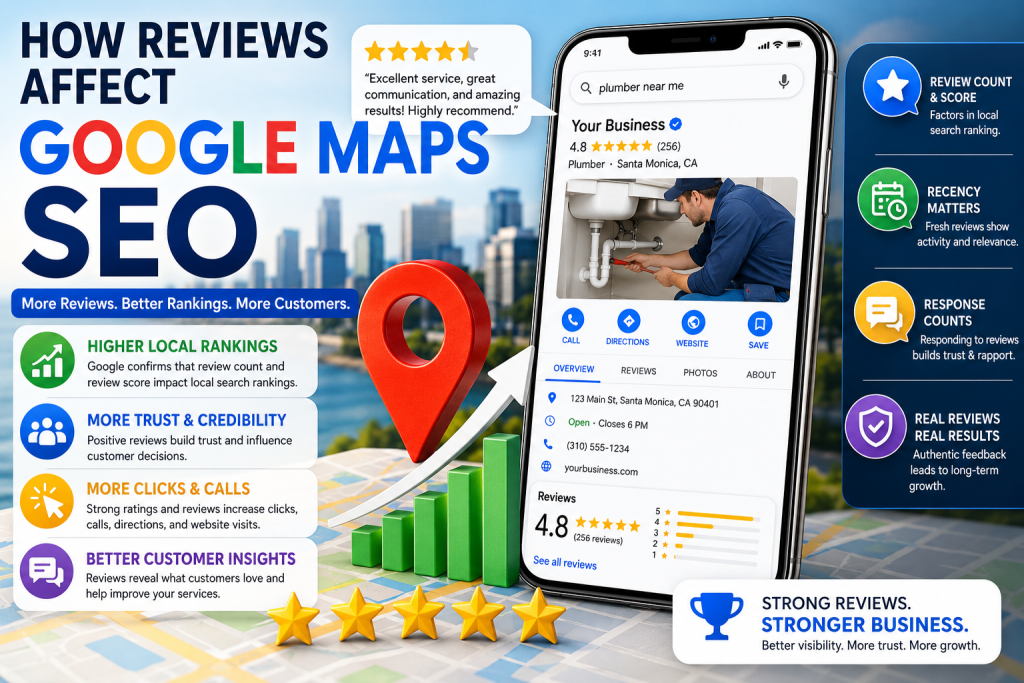
How Reviews Affect Google Maps SEO: Why Customer Reviews Matter for Local Rankings, Trust, and AI Search Visibility
Reviews affect Google Maps SEO because they help Google and customers understand the trust, quality, relevance, and reputation of a local business. When a business has real customer reviews, strong ratings, consistent review activity, and professional review responses, it can improve how customers interact with the business in Google Maps and local search.
Google states that review count and review score factor into local search ranking, and that more reviews and positive ratings can improve a business’s local ranking. Google explains this in its official local ranking documentation here: Tips to improve your local ranking on Google.
For local SEO, reviews are more than testimonials. They support prominence, conversion, customer confidence, service relevance, and brand trust. For AI search and LLM visibility, reviews can also help reinforce how customers describe the business, what services they mention, and whether the company appears credible across the web.
This is why reviews should be part of a complete Google Maps SEO company strategy, not treated as a separate reputation task.
What Are Google Reviews?
Google reviews are customer reviews left on a business’s Google Business Profile. They usually include a star rating, written feedback, photos when added by the customer, and sometimes details about the service or experience.
These reviews appear on Google Search and Google Maps when users find the business profile. They can influence whether a customer calls, clicks, books, requests directions, reads more, or chooses a competitor.
For local businesses, Google reviews are one of the most visible trust signals online.
A business can have a strong website, good service pages, clean citations, and a complete Google Business Profile, but if the review profile is weak, outdated, or poorly managed, customers may hesitate before contacting the business.
Why Reviews Matter for Google Maps SEO
Google Maps SEO is built around helping Google understand which local businesses are relevant, nearby, and trusted enough to show for a search.
Google’s local ranking system is mainly based on relevance, distance, and prominence. Reviews support prominence because they help show how well-known, trusted, and active a business appears online.
Reviews also support customer behavior. A strong review profile can increase clicks, calls, website visits, bookings, and direction requests. These actions matter because Google Maps is not just a ranking platform. It is a customer decision platform.
When customers compare businesses in Google Maps, they often look at:
- Average star rating
- Total number of reviews
- Recent reviews
- Review content
- Owner responses
- Photos in reviews
- Service mentions
- Negative review handling
A business with strong reviews can often earn more trust than a business with a similar ranking but weaker reputation signals.
Review Count and Review Score
Review count refers to how many reviews your business has.
Review score refers to your average rating.
Both matter because Google specifically says review count and review score factor into local search ranking. A business with more positive reviews can send stronger trust and prominence signals than a business with very few reviews or poor ratings.
However, review count alone is not enough.
A business with 500 reviews and a poor rating may struggle with trust. A business with 25 excellent reviews may still need more review volume to compete in a crowded market. A business with many old reviews but no recent feedback may look less active than competitors receiving steady reviews.
The strongest review profiles usually have a combination of:
- High average rating
- Steady review growth
- Recent customer feedback
- Detailed written reviews
- Service-specific mentions
- Professional owner responses
- Authentic customer experiences
Review Recency Matters
Recent reviews help show that a business is active and still serving customers.
If a business has many reviews but the most recent review is from two years ago, customers may wonder if the business is still active, still trusted, or still providing the same quality of service.
Review recency can also affect conversion. A customer comparing two businesses may choose the one with recent positive feedback because it feels more current and reliable.
For Google Maps SEO, review recency supports the overall freshness of the business profile. It shows ongoing customer engagement and reinforces that the business is still relevant in the local market.
The goal is not to get a large number of reviews once and stop. The goal is to build a consistent review system over time.
Review Content and Keyword Relevance
Review content can help reinforce what a business is known for.
When customers naturally mention services, locations, staff names, problems solved, or specific experiences, those reviews create helpful context around the business.
For example, a review for an SEO company may mention Google Maps SEO, local SEO, Google Business Profile optimization, rankings, leads, or business growth.
A review for a dentist may mention dental implants, emergency dentistry, teeth cleaning, Invisalign, or cosmetic dentistry.
A review for a contractor may mention roof repair, kitchen remodeling, water damage, or emergency service.
This does not mean businesses should tell customers what keywords to use. Reviews should be natural and authentic. However, detailed customer feedback often includes important service language that helps customers and search systems understand the business better.
Review content can support NLP and entity understanding because it gives search engines and AI systems more natural language around what customers associate with the business.
Reviews and Prominence
Prominence is one of Google’s core local ranking factors.
Google describes prominence as how well-known a business is and explains that it is based on information Google has about a business from across the web, including links, articles, directories, review count, and review score.
This is why reviews are important for local prominence.
Reviews show public feedback. They create visible proof that customers have interacted with the business. They also help distinguish one business from another in competitive local search results.
If two businesses have similar categories, locations, citations, and websites, the business with stronger reviews may have an advantage in trust and conversion.
Reviews and Customer Conversion
Google Maps SEO is not only about ranking higher. It is about turning visibility into calls, visits, bookings, and leads.
Reviews are one of the strongest conversion factors because they influence customer decisions directly.
A customer may find your business in the local pack, but reviews often determine whether they click your profile or choose someone else.
Reviews help answer customer questions such as:
- Can I trust this business?
- Do other customers recommend them?
- Do they provide the service I need?
- Do they respond professionally?
- Are recent customers happy?
- Is the rating strong compared to competitors?
- Does the business seem active?
A strong review profile can improve click-through rates, call volume, direction requests, website visits, and appointment requests.
Review Responses Matter
Review responses show that a business is active, professional, and attentive to customers.
Google provides instructions for business owners to read and reply to reviews through their Business Profile. You can read Google’s official review management guidance here: Manage customer reviews on Google.
Responding to reviews is important because potential customers read both the review and the business response. A professional response can strengthen trust, even when the review is negative.
Good review responses should be:
- Professional
- Polite
- Specific when appropriate
- Short enough to read easily
- Helpful
- Respectful of customer privacy
- Consistent with the brand voice
Google’s guidance on getting more reviews also recommends keeping replies professional, polite, clear, helpful, short, simple, direct, and honest. You can reference that source here: Tips to get more reviews on Google.
How to Respond to Positive Reviews
Positive reviews should be acknowledged with appreciation.
A good positive review response should thank the customer, reinforce the service when natural, and show that the business values the relationship.
For example, instead of writing the same response every time, a business can write a short response that feels human:
Thank you for the kind words. We appreciate you trusting us with your local SEO campaign and are glad the Google Business Profile improvements helped your business receive more visibility.
This type of response feels more specific than a generic “Thanks for your review.”
However, responses should not be over-optimized or stuffed with keywords. The goal is to communicate with customers, not manipulate search results.
How to Respond to Negative Reviews
Negative reviews should be handled carefully.
A negative review response should stay calm, professional, and factual. It should avoid arguing, blaming, revealing private customer information, or escalating the situation.
A good response may include:
- Acknowledgment of the concern
- A professional tone
- A willingness to discuss offline
- A contact option
- No private details
- No emotional language
For example:
Thank you for your feedback. We take customer concerns seriously and would like the opportunity to better understand what happened. Please contact our team directly so we can review this and work toward a resolution.
Negative reviews are not always bad for credibility. A business with only perfect reviews may look less realistic to some users. What matters is how the business responds and whether the overall review profile shows trust.
Can You Remove Bad Google Reviews?
Businesses cannot remove reviews simply because they are negative.
However, Google allows businesses to report reviews that violate Google policies. Google states that if you find a review on your Business Profile that violates its policies, you can report it for removal. You can read Google’s official guidance here: Report inappropriate reviews on your Business Profile.
Examples of reviews that may violate policies can include spam, fake engagement, offensive content, conflicts of interest, or irrelevant content, depending on the situation and Google’s policy review.
Google’s Maps user-generated content policy explains rules around contributions and prohibited content. You can review Google’s policy source here: Google Maps user-generated content policy.
If a review does not violate policy, the best option is usually to respond professionally and continue building legitimate positive reviews over time.
Fake Reviews and Review Manipulation
Fake reviews can damage trust and create risk.
Businesses should not buy reviews, create fake customer accounts, review their own business, ask employees to leave fake reviews, or pressure customers into leaving misleading feedback.
Review manipulation can hurt the business if customers notice unnatural patterns. It can also violate platform policies.
The best long-term review strategy is simple:
Provide a good customer experience, ask real customers for honest feedback, make the review process easy, and respond professionally.
Real reviews build trust. Fake reviews create risk.
How to Get More Google Reviews the Right Way
Google encourages businesses to remind customers to leave reviews and explains that businesses can share a link with customers to leave a review. Google’s review guidance says customers can leave reviews when they have had an experience with the business and that business owners can share a review link. You can read Google’s official guidance here: Tips to get more reviews.
To get more reviews the right way, businesses should create a repeatable process.
This can include:
- Asking after a successful customer interaction
- Sending a review link by email or text when appropriate
- Training staff to request reviews naturally
- Adding review requests to follow-up workflows
- Including review links in thank-you messages
- Making the process simple for customers
- Responding to reviews consistently
The review request should be simple and honest.
For example:
Thank you for choosing us. If you had a good experience, we would appreciate your honest feedback on Google. Your review helps other local customers learn more about our business.
Reviews and Google Business Profile Optimization
Reviews work best when the Google Business Profile is fully optimized.
If the profile has accurate categories, services, hours, photos, products, posts, Q&A, and business information, reviews have a stronger foundation to support.
For example, if customers mention services in reviews, those services should also be listed on the profile and supported by website content.
If customers mention a specific location or service area, the profile and website should reflect accurate location information.
If customers mention strong service outcomes, the website should explain those services clearly.
This is why reviews should connect to broader best practices for Google Business Profiles.
Reviews and Schema Markup
Reviews can also connect to structured data when they are eligible and follow Google’s guidelines.
Google’s Review snippet structured data documentation explains that when Google finds valid reviews or ratings markup, it may show a rich snippet with stars or other summary information. You can read the official documentation here: Review snippet structured data.
However, review schema should be used carefully. Not all review situations are eligible, and the markup must follow Google’s structured data guidelines.
Schema markup should match visible page content and should not be used to mislead search engines. If your website uses review-related structured data, it should be accurate, compliant, and connected to real review content.
For the larger local SEO structure, reviews and schema work together because schema helps organize business information, while reviews help prove customer trust. You can learn more in this article on the benefits of schema markup for local SEO.
Reviews and AI Search Visibility
AI search and large language models need reliable information to understand and summarize businesses.
Reviews can contribute to AI understanding because they provide customer-generated language about the business. When many customers describe the same business positively and mention similar services, that can reinforce what the business is known for.
For example, if customers repeatedly mention Google Maps SEO, local SEO, Google Business Profile optimization, rankings, communication, and results, AI systems may have more context around the business’s service focus.
This matters for AEO and GEO.
AEO, or Answer Engine Optimization, focuses on making information easier for search systems to answer.
GEO, or Generative Engine Optimization, focuses on making a business easier for AI systems to understand, summarize, and recommend.
Reviews support this process by adding real-world customer language, proof, and context.
Reviews and E-E-A-T
E-E-A-T stands for experience, expertise, authoritativeness, and trustworthiness.
Reviews can support E-E-A-T because they show real customer experiences with the business.
For a local business, reviews can help demonstrate:
- Experience delivering the service
- Customer satisfaction
- Trustworthiness
- Service quality
- Responsiveness
- Local reputation
- Consistency over time
Reviews should be supported by other trust signals, including clear business information, helpful website content, real photos, case studies, citations, schema markup, and a complete Google Business Profile.
Reviews alone do not prove expertise, but they help customers and search systems see evidence of customer trust.
Reviews and Service Relevance
Reviews can reinforce service relevance when customers naturally mention what they hired the business for.
For example, if a business wants to be known for local SEO, reviews mentioning local SEO strategy, Google Maps rankings, Google Business Profile optimization, citations, leads, and SEO results can help support that business identity.
The same applies to other industries.
A dentist may receive reviews mentioning dental implants, cleanings, emergency visits, or cosmetic procedures.
A contractor may receive reviews mentioning roof repair, kitchen remodels, or water damage restoration.
A law firm may receive reviews mentioning communication, settlement help, legal guidance, or injury cases.
This natural language helps future customers understand what the business does well.
Reviews and Local Trust
Local customers often rely on reviews because they want proof from other people in the same market.
A business with strong reviews appears more trustworthy because customers can see that others have already used the service.
This is especially important in competitive local industries where many businesses offer similar services.
Local trust can be strengthened through:
- Recent positive reviews
- Detailed customer feedback
- Professional owner responses
- Photos from customers
- Service-specific mentions
- Consistent business information
- Strong website content
- Clean Google Business Profile optimization
Reviews help reduce risk in the customer’s mind.
Reviews and Click-Through Rate
When a business appears in Google Maps or the local pack, users often compare ratings before clicking.
A higher rating and stronger review count can increase the chance that users click your listing instead of a competitor’s listing.
This matters because visibility does not guarantee traffic.
If a business ranks but has poor reviews, customers may skip it.
If a business ranks and has strong reviews, it has a better chance of earning the click, call, or direction request.
Google Maps SEO should always consider both ranking and conversion.
Reviews and Negative Feedback Patterns
One negative review is usually not the problem.
Patterns are the problem.
If multiple reviews mention poor communication, missed appointments, bad customer service, pricing issues, or quality problems, customers will notice. Search engines and AI systems may also see repeated language that affects how the business is understood.
Businesses should use negative review patterns as operational feedback.
If the same issue appears repeatedly, the business should fix the underlying problem rather than only responding to reviews.
Review management is not only SEO. It is customer experience improvement.
Reviews and Competitor Comparison
Reviews are often one of the first things customers use to compare local competitors.
When three businesses appear in the local pack, a customer may compare the star rating, number of reviews, recency, and review wording before choosing who to call.
For example:
- Business A has 12 reviews and a 4.1 rating.
- Business B has 95 reviews and a 4.8 rating.
- Business C has 240 reviews and a 4.9 rating with recent detailed reviews.
Even if all three businesses rank, the review profile can strongly influence which business earns the lead.
This is why review generation should be ongoing.
How Often Should a Business Get Reviews?
There is no exact number of reviews every business needs per month.
The right pace depends on the industry, customer volume, competition, and service type.
A restaurant, med spa, dentist, or retail business may naturally receive more frequent reviews than a high-ticket B2B service provider.
The goal is consistency.
A business should avoid sudden unnatural spikes followed by long periods of no reviews. A steady review pattern looks more natural and gives customers current feedback.
For competitive local SEO, businesses should monitor how frequently top competitors receive reviews and build a realistic process to stay competitive.
Common Review Mistakes That Hurt Google Maps SEO
Many businesses lose review opportunities because they do not have a system.
Common review mistakes include:
- Not asking customers for reviews
- Only asking once
- Making the review process difficult
- Ignoring reviews after they are posted
- Responding emotionally to negative reviews
- Using the same generic response every time
- Buying fake reviews
- Asking for only positive reviews
- Ignoring review policy violations
- Not tracking competitors
- Not connecting reviews to service quality
- Failing to fix repeated customer complaints
The best review strategy is simple, ethical, and consistent.
How to Build a Review Strategy for Local SEO
A strong review strategy should be built into the customer journey.
Start by identifying the best moment to ask for a review. This is usually after the service is completed, after the customer expresses satisfaction, after a successful appointment, or after a positive result.
Then make the request simple.
Use a direct Google review link when appropriate. Keep the message short. Ask for honest feedback. Do not pressure the customer or tell them what to say.
Next, assign responsibility.
Someone in the business should be responsible for requesting reviews, monitoring reviews, responding to reviews, reporting policy violations, and tracking review growth.
Finally, measure results.
Track total reviews, average rating, review frequency, response rate, competitor reviews, and how reviews affect calls, clicks, and leads.
How to Measure Review Performance
Review performance should be tracked like any other local SEO signal.
Important review metrics include:
- Total review count
- Average rating
- Review frequency
- Review recency
- Review response rate
- Keywords and services mentioned in reviews
- Negative review themes
- Competitor review count
- Competitor average rating
- Review-related conversion changes
- Google Business Profile calls and clicks
Review tracking should be connected to Google Maps ranking tracking and Google Business Profile performance.
The goal is to understand whether reviews are helping improve visibility, trust, and customer actions.
Final Thoughts
Reviews affect Google Maps SEO because they support trust, prominence, relevance, customer behavior, and conversion.
Google states that review count and review score factor into local search ranking. Customers also use reviews to decide which business to trust. AI systems can use review language to better understand what a business is known for.
A strong review strategy should focus on real customer experiences, steady review growth, professional responses, policy compliance, and customer experience improvement.
Reviews work best when combined with a complete Google Business Profile, accurate categories, service pages, local citations, schema markup, consistent branding, and ongoing Google Maps ranking tracking.
For local businesses, reviews are not optional. They are one of the most visible and influential parts of local SEO.
FAQs
Do reviews affect Google Maps SEO?
Yes, reviews affect Google Maps SEO. Google states that review count and review score factor into local search ranking, and that more reviews and positive ratings can improve local ranking. Reviews also influence customer trust, click-through rates, calls, website visits, and direction requests.
How many Google reviews do I need to rank higher?
There is no exact number of reviews that guarantees higher rankings. The number needed depends on your competition, industry, location, category, website strength, citations, and overall Google Business Profile optimization. The goal is to build steady, real, positive reviews over time.
Is review score more important than review count?
Both review score and review count matter. A high rating helps build trust, while a strong review count shows volume and customer activity. A business with many positive, recent, detailed reviews usually has a stronger review profile than a business with very few reviews or outdated feedback.
Do review responses help local SEO?
Review responses help show that a business is active, professional, and engaged with customers. While responses are also important for reputation and conversion, they support trust by showing future customers how the business communicates.
Can I remove negative Google reviews?
You cannot remove a review just because it is negative. However, you can report a review if it violates Google’s policies. If the review does not violate policy, the best approach is to respond professionally and continue building legitimate positive reviews.
Should I ask customers for Google reviews?
Yes, businesses can ask customers for honest reviews. Google allows businesses to share a review link with customers. The request should be simple, professional, and honest. Businesses should not pressure customers, buy reviews, or request fake feedback.
Do keywords in reviews help Google Maps rankings?
Customer review wording can help reinforce service relevance when it is natural. If customers mention real services, locations, or experiences, that creates helpful context. Businesses should not tell customers what keywords to use, but detailed authentic reviews can support relevance and customer understanding.
Do fake reviews hurt local SEO?
Fake reviews can hurt trust and create policy risk. Customers may notice unnatural review patterns, and Google may remove reviews that violate policies. The best long-term review strategy is to earn honest feedback from real customers.
How often should I get new reviews?
Review frequency depends on your industry and customer volume. The goal is steady review growth over time. A consistent flow of recent reviews looks more natural and helps customers see that the business is active.
How do reviews help AI search visibility?
Reviews can help AI search visibility by adding customer-generated language about the business. When reviews consistently mention services, results, locations, and customer experiences, AI systems have more context to understand what the business does and why customers trust it.